

2014: Big blockbusters, small paybacks | Bollywood News
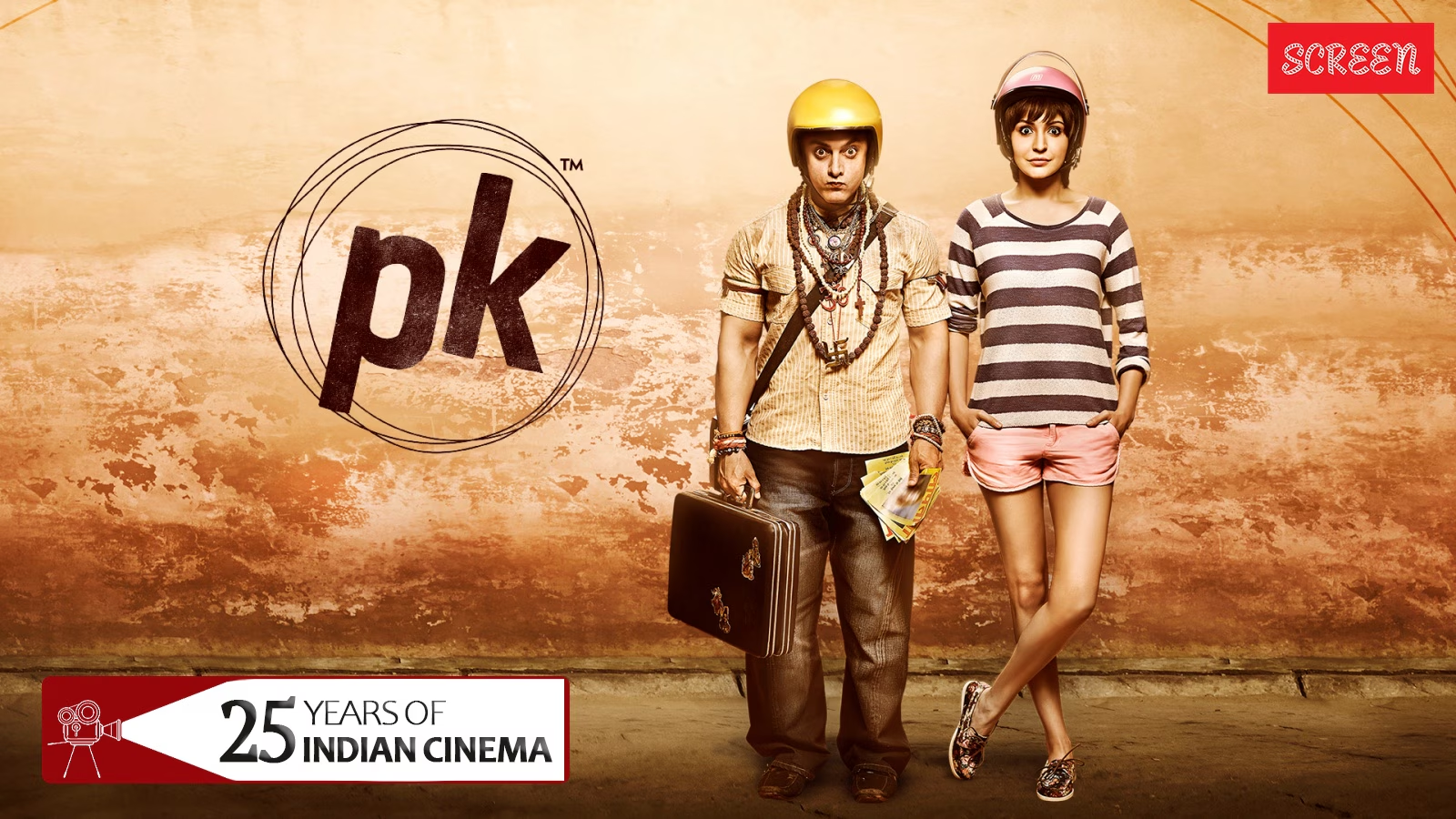

Of the top grossers, which included same-old starry turns with same-old treatment — Kick, Bang Bang, Singham Returns, Holiday, Happy New Year, Ek Villain — only PK stood tall for its freshness. Rajkumar Hirani directed Aamir Khan as the big-eared, saucer-eyed alien landing on earth and fixing its troubles, while learning a few lessons along the way.
Ali Abbas Zafar’s Gunday gave Irrfan Khan yet another of his cop roles, and yet another supporting role in a YRF film, this time working alongside Ranveer Singh, Arjun Kapoor and Priyanka Chopra, being yet again the best part of a masala movie. It was the year when several female-centric films broke out of the formulaic mould.
There was Priyanka Chopra as the titular character in Omung Kumar’s Mary Kom, and Rani Mukherji in and as Mardaani, directed Pradeep Sarkar and produced Aditya Chopra.
Mary Kom (2014) – Priyanka Chopra as Mary Kom.
Conducting herself credibly, Priyanka faced down the murmurs that someone from the North East, if not Mary Kom herself, should have played her character in the biopic; Mukherji as a tough cop doing the right thing was impactful.
CHECK OUT ALL STORIES FROM 25 YEARS OF INDIAN CINEMA
Imtiaz Ali’s Highway gave Alia Bhatt, with terrific co-star Randeep Hooda, one of her breakout performances, in which she plays a young girl on the run. It set the 19-year-old Bhatt on the path of films which would challenge her, and she has made good on that early promise, becoming one of the most successful stars in Bollywood.
Hasee Toh Phasee, directed Vinil Mathew and produced Dharma, was a rom com with a difference. It welcomed Sidharth Malhotra back to Dharma, and got Parineeti Chopra in its fold, and the two — a wannabe entrepreneur and an eccentric scient — made one of the most unusual pairs in Hindi cinema.
Sidharth Malhotra and Parineeti Chopra’s Hasee Toh Phasee was bankrolled Karan Johar.
Vishal Bhardwaj’s third of his Shakespeare tragedies, the Hamlet-inspired Haider, isn’t as striking as the earlier Maqbool’ and Omkara, but it gave Shahid Kapoor, working with Kay Kay and Tabu, one of his best roles: being set in Kashmir, a place beset with so much contestation even today, lends it continual resonance.Story continues below this ad
But of the films that year that were truly different, Rajat Kapoor’s Aankhon Dekhi would be right on top. Through a character, played flawlessly Sanjay Mishra, who decides to believe only what he can see with his own eyes, Kapoor weaves a magnificent tale of belief and perception, his unique injection of whimsy making it one of my all-time favourite Hindi films.
And then there was Ashim Ahluwalia’s terrific Miss Lovely which revolved around the sleazy C-grade sex-and-horror films so popular in the 80s, focussing on the ecosystem which produced these films. The creation of that parallel Bollywood era which doesn’t ex anymore, made in a most un-Bollywood-like manner, is unparalleled.