No calculator allowed: Can you solve this tricky maths brain teaser that stumped the internet? | Trending
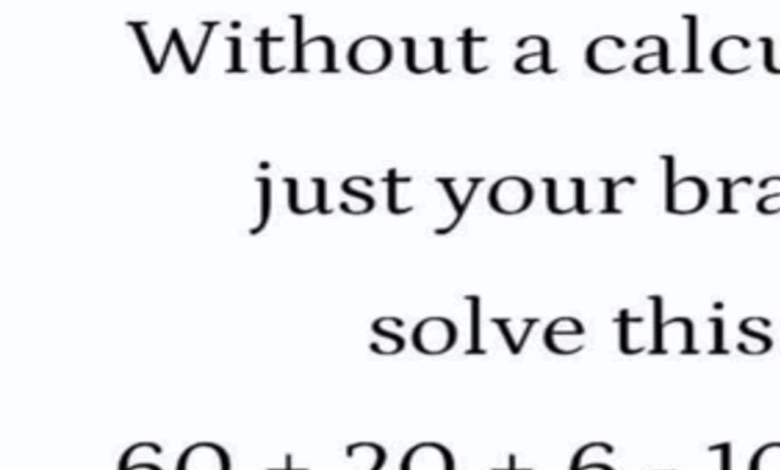

For many of us, mathematics in school was more a source of stress than excitement. However, the growing popularity of brain teasers with a mathematical tw is turning that notion on its head. These clever puzzles blend logic, numbers, and a touch of misdirection, transforming maths into something enjoyable, intriguing, and even addictive. A brain teaser shared on X puzzled users.(X/@9Laura_M) (Also read: Test your logic skills: You’re a true puzzle master if you can solve this tricky maths riddle) Whether you’re a self-proclaimed numbers nerd or someone who vowed never to revisit algebra, there’s something undeniably compelling about a challenge designed to outwit the average mind. In the age of rapid scrolling and fleeting attention spans, a good brain teaser offers a perfect moment of mental engagement—short, sharp, and satisfying. The puzzleA brain teaser recently shared a user named Laura Michelle has left the internet both amused and confused. The challenge is to solve a deceptively simple-looking equation using nothing but your brain: “Without a calculator, just your brain, solve this: 60 + 20 + 6 – 10 × 0 = ?” Check out the brain teaser here: Another puzzleThis isn’t the first time a maths-based puzzle has baffled social media users. An earlier post X (formerly Twitter) user @BholanathDutta went viral for its unconventional set of equations: “If 7 × 7 = 12, 5 × 5 = 8, 3 × 3 = 4, 2 × 2 = 2, Then 6 × 6 = ?” Unlike the typical arithmetic problems, this teaser relies on pattern recognition rather than mathematical accuracy. It’s not about the right answer in a traditional sense—it’s about spotting the underlying logic, or perhaps even inventing one, which has kept users debating, guessing, and theorising. (Also read: Intelligence test: Only those with sharp logic can crack this mind-bending brain teaser) The enduring charm of brain teasersWhat makes these brain teasers so enduringly popular is their ability to challenge us in unexpected and engaging ways. They disrupt routine thinking, test our mental agility, and often lead to moments of surprise, satisfaction, and even a bit of self-reflection when we realise how easily we can be tricked simple logic. So, have you cracked the code yet?