

Trump’s new tariffs hit over 70 nations: Who’s affected and how | World News
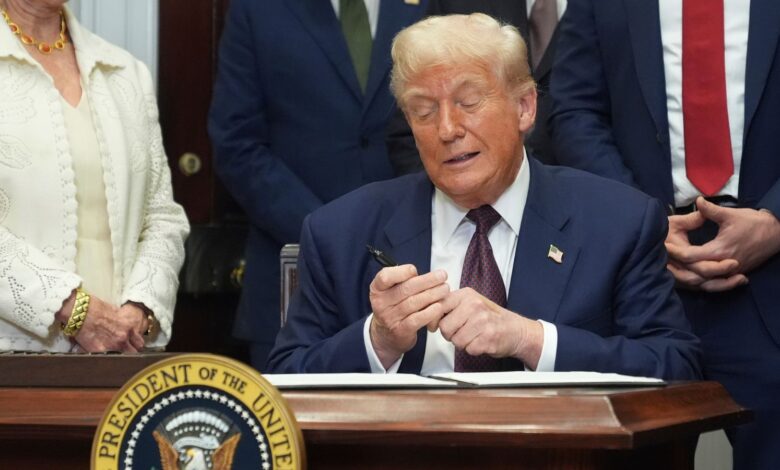

US President Donald Trump unveiled an executive order late Thursday night imposing new tariffs on a wide array of American trading partners. The sweeping measure affects 68 countries and all 27 members of the European Union, with rates set to take effect on August 7. The tariff rollout, originally scheduled for August 1, was delayed a week to allow time for finalising the rate schedule, a senior adminration official told AP.
On a Truth Social post earlier, Trump wrote: “The August First deadline is the August First deadline – it stands strong, and will not be extended. A big day for America!!!”
How the new tariffs work
According to CNN, the baseline tariff for goods coming into the US will remain at 10%, but only for countries with which the US enjoys a trade surplus — that is, nations from which the US imports less than it exports.
Story continues below this ad
For about 40 countries with which the US has a trade deficit, a 15% tariff will now apply. The new system is reportedly based on fairness and the trade imbalance each nation holds with the United States, a senior official told AP.
Here are the key tariff rates at a glance:
But the real sting lies in a l of 26 countries that now face tariffs above 15%, largely due to what the White House describes as excessive trade deficits.
Countries facing tariffs above 15%
According to a White House announcement as cited CNN, here are the nations with the highest imposed rates:
Laos, Myanmar, Syria – 40%
Switzerland – 39%
Iraq, Serbia – 35%
Algeria, Bosnia, Lia, South Africa – 30%
India, Brunei, Kazakhstan, Moldova, Tunisia – 25%
Bangladesh, Sri Lanka, Taiwan, Vietnam – 20%
Cambodia, Indonesia, Malaysia, Pakan, Philippines, Thailand – 18–19%
Countries like India (25%) and Vietnam (20%) — both considered key to Washington’s China pivot — now face significant barriers, raising concerns about long-term US supply chain strategies.Story continues below this ad
Even the United States-Mexico-Canada Agreement (USMCA) members, once considered exempt, aren’t spared. On Thursday:
Mexico agreed to a 90-day extension of the current 25% rate on non-exempt goods.
Canada will now face a 35% tariff, up from 25%, effective immediately.
Winners and negotiators
Some countries have managed to avoid the worst. Thailand, for example, saw its proposed tariff slashed from 36% to 19% after last-minute talks.
“It’s one of the major successes of Team Thailand… a win-win,” said Thai government spokesperson Jirayu Houngsub, as per AP.
The Trump adminration also confirmed it had reached new trade frameworks with Japan, South Korea, the EU, Indonesia, and the Philippines, though the final terms remain undisclosed.Story continues below this ad
Trump’s tariff agenda builds on his earlier “Liberation Day” tariffs from April, which triggered stock market volatility. “Because these deals are so vague and unfinished, policy uncertainty will remain very elevated,” said Scott Lincicome, econom at the Cato Institute, according to AP.
(With inputs from AP, CNN)