

Will a Gen Z Uprising or a Resurgent Islam Party Define the New Era?
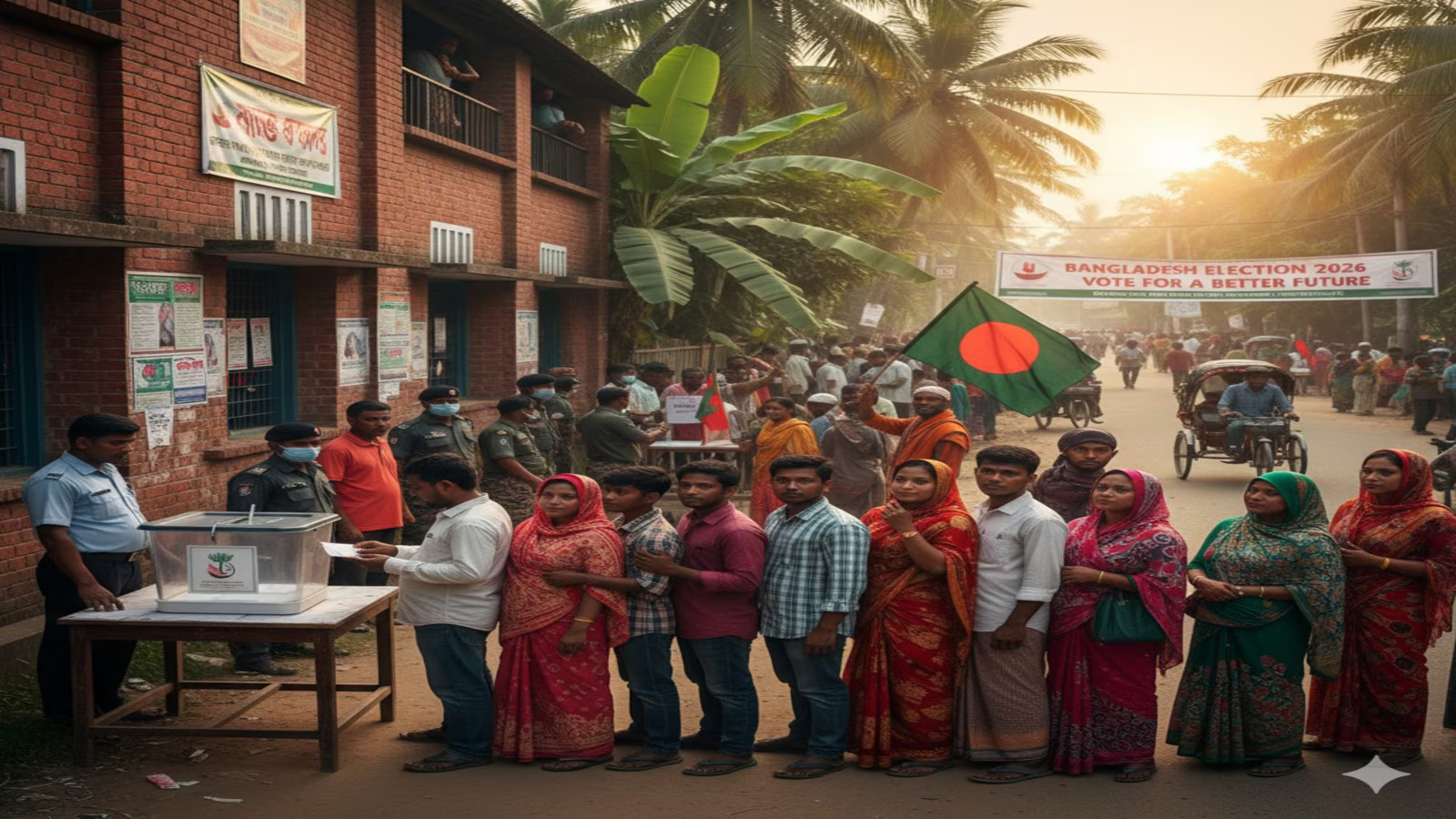

Bangladesh’s general election on Thursday, February 12, 2026, will be the country’s first national vote since former prime miner Sheikh Hasina was ousted in a youth-led uprising in 2024, ending her 15-year rule.The election will bring to a close an 18-month transition overseen an interim adminration led Nobel laureate Muhammad Yunus. Alongside the parliamentary polls, voters will also take part in a referendum on constitutional reforms, making the exercise a test not just of political leadership but of Bangladesh’s democratic reset.Public anger had been building for years over allegations of election rigging, shrinking civil liberties and the suppression of opposition under Hasina’s government. These tensions exploded in 2024 when student-led protests were met with a violent security crackdown that left hundreds dead and eventually forced Hasina into exile in India.
A demonstrator gestures as protesters clash with Border Guard Bangladesh (BGB) and the police outside the state-owned Bangladesh Television as violence erupts across the country after anti-quota protests students, in Dhaka, Bangladesh. (File/ Reuters)
For many voters, memories of that period shape their expectations from the election. “I don’t want any more bad incidents in Bangladesh, or a war-like situation,” news agency AP quoted Arefin Labib as saying, who referred to the violence during the uprising. “If the country wants to run smoothly, then a fair election is needed.”
Who are the main political contenders?
The election is effectively a contest between two major coalitions, according to Reuters.
BNP-led coalition
The Bangladesh National Party (BNP) is contesting 292 of the 300 parliamentary seats, leaving the rest to more than half a dozen smaller coalition partners. Opinion polls suggest the BNP-led alliance holds a narrow edge.
In this image posted on Dec. 31, 2025, Bangladesh Chief Adviser Professor Muhammad Yunus and BNP Chairman Tarique Rahman, with others during the funeral prayers of the latter’s mother and the country’s former prime miner Khaleda Zia, in Dhaka. (@ChiefAdviserGoB/X via PTI Photo)
The BNP is led Tarique Rahman, the 60-year-old son of former prime miner Khaleda Zia and former president Ziaur Rahman. His campaign promises include:Story continues below this ad
Financial aid for poor families.
A 10-year cap on how long an individual can remain prime miner.
Attracting foreign investment to revive growth.
Anti-corruption measures.
Jamaat-e-Islami–led 11-party coalition
The Islam Jamaat-e-Islami, banned for years under Hasina, has resurged since her fall and is contesting 224 seats. Its key ally, the National Citizen Party (NCP), led Gen Z activs, is contesting 30 seats, with the rest split among smaller partners.
If the Jamaat-led alliance wins, its chief Shafiqur Rahman is expected to become prime miner.
Who is Shafiqur Rahman, and why has he emerged as a serious contender?
Once a marginal figure in national politics, Shafiqur Rahman, 67, has risen rapidly since 2024 to become one of the most prominent faces of the election.
A doctor training and Jamaat chief since 2020, Rahman was previously jailed under Hasina’s rule, and the party was driven underground. That changed after the uprising, when the interim government eased restrictions, and a court lifted Jamaat’s ban in 2025.Story continues below this ad
Bangladesh Jamaat-e-Islami Ameer Dr Shafiqur Rahman has invited BNP Acting Chairman Tarique Rahman to take part in an open, public debate. (File Photo)
Rahman has since toured the country, overseen charity and flood-relief drives, and projected Jamaat as a clean, anti-corruption alternative.
“We tried to raise our voice, but repeatedly it was suppressed,” he told Reuters. “After the uprising, we got a chance to come again to the surface.”
Analysts say he capitalised on a leadership vacuum. “There was no visible leader in Bangladesh after the uprising,” said Dhaka University professor Shafi Md Mostafa. “Within barely two years, Rahman became a frontrunner.”
However, his views on women have sparked controversy. Jamaat has not fielded a single female candidate, and Rahman has drawn criticism for remarks suggesting limits on women’s work outside the home, fuelling anxiety among women and minorities.Story continues below this ad
What are the main issues driving voters?
According to Reuters, voters heading to the polls are focused on five major concerns:
Corruption: Ranked the top concern in opinion polls. Bangladesh consently performs poorly on Transparency International’s Corruption Perceptions Index. Both BNP and Jamaat have made anti-graft pledges central to their campaigns.
Inflation: Inflation stood at 8.58% in January, with rising prices cited as a major worry more than two-thirds of respondents.
Economic development: Once among Asia’s fastest-growing economies, Bangladesh has struggled since COVID-19 and the disruption of its export-driven garments sector during the 2024 unrest.
Employment: With around 40% of the population under 30, job creation is a key pressure point for the next government.
Ban on Awami League: Hasina’s Awami League has been barred from contesting. Surveys suggest nearly half of former Awami League voters now favour the BNP, while about 30% lean toward Jamaat.
What are ordinary voters saying?
Beyond party politics, voters repeatedly link democratic legitimacy to security and stability. “I want the government to prevent riots, killings, and any other trouble,” Zainul Abedeen, a 62-year-old street vendor in Dhaka, told AP.
Others say the interim government stabilised the economy but failed to deliver deeper reforms. “The political situation was so fragmented that it couldn’t sort it out,” said Dhaka resident Rajit Hasan. “We want democracy. We want our rights. We want the rule of law.”Story continues below this ad
Why are women particularly anxious about this election?
Bangladesh was long governed women prime miners, Khaleda Zia and Hasina, giving many women a sense of representation. That legacy now appears under threat.
Fewer women are contesting seats despite their visible role in the protests that led to the election.
“One of my primary hopes was that there would be more women leaders and women’s issues would be prioritised,” said economics student Wasima Binte Hussain. “It hasn’t been prioritised that much.”
Concerns have deepened with Jamaat’s resurgence. For 22-year-old student Sayma Nowshin Suha, the fear is ideological. “In Bangladesh,” she said, “conservatism is the scariest thing.”Story continues below this ad
What is at stake beyond this election?
With nearly 128 million voters in one of the world’s youngest electorates, the February 12 vote will determine whether Bangladesh can translate protest-driven change into stable democratic governance.
For many, this election is not just about who forms the next government — but about whether Bangladesh can restore trust in its institutions after years of political turmoil.
Key election schedule
Event
Date
Start of campaign period
January 22, 2026
End of campaign period
February 10, 2026 (today)
Election day (polling)
February 12, 2026
Counting of votes
February 12, 2026 (begins immediately after polls close)