How Tarique Rahman’s Landslide Win and a ‘Yes’ to Term Limits Just Reset Bangladesh
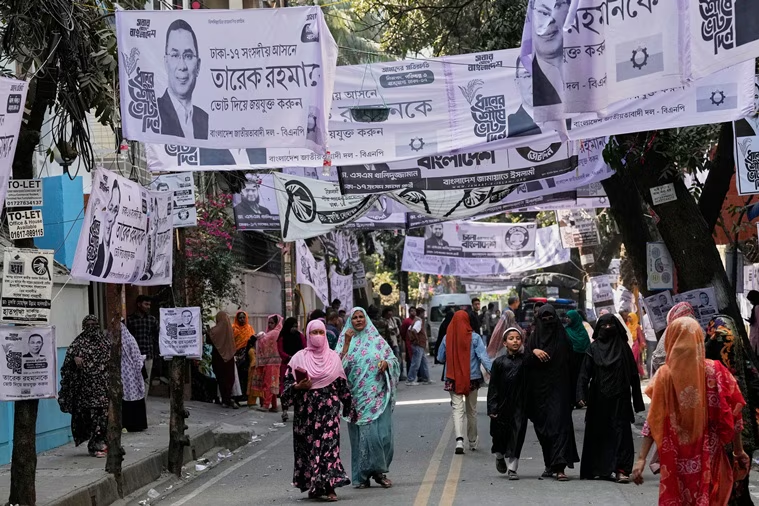

Bangladesh Election Results 2026: Bangladesh’s opposition Bangladesh National Party (BNP) won a landslide parliamentary election on Friday, returning to power after nearly two decades and positioning party leader Tarique Rahman to become prime miner as the country emerges from months of unrest and economic disruption.Rahman, 60, the son of former premier Khaleda Zia and assassinated former President Ziaur Rahman, now stands on the cusp of leading a country still recovering from the political shockwaves of 2024.An interim government led Nobel laureate Muhammad Yunus has been in charge since the collapse of former Prime Miner Sheikh Hasina’s government in 2024.The official count in a vote viewed as the South Asian nation’s first truly competitive election in years gave the BNP and its allies at least 212 out of 299 seats, the Election Commission said.
“A strong majority gives the BNP the parliamentary strength to pass reforms efficiently and avoid legislative paralysis. That alone can create short-term political stability,” said Selim Raihan, an economics professor at the University of Dhaka.
Rahman did not comment after trends in favour of his party became clear. He smiled and waved from his vehicle to journals gathered outside his house in Dhaka as he left for a mosque.
The BNP asked supporters to exercise restraint.
“Despite winning … a large margin of votes, no celebratory procession or rally shall be organised,” the party said.Story continues below this ad
The Jamaat-e-Islami conceded defeat late on Thursday once trends became clear but said on Friday it was “not satisfied” with the process.
The party won a record 68 seats in its first election since a 2013 ban on it was lifted after Hasina’s ouster — a significant showing but not enough to challenge the BNP.
The National Citizen Party, led youth activs who helped topple Hasina, won just six of the 30 seats it contested, highlighting the difficulty of converting street momentum into electoral success.
Hasina’s Awami League, which ruled for 15 years, was barred from contesting this time. In 2008, it secured 230 seats.
Voter turnouts
2026: 60%2024: 42%Story continues below this ad
This sharp rise signals renewed public engagement after months of unrest.
Key winners
BNP and allies: The biggest winner of the election. With 212 out of 299 seats, the BNP has crossed the majority mark comfortably and is set to return to power after nearly two decades.
Tarique Rahman: The BNP chief is poised to become prime miner, marking a dramatic political comeback for both him and the party.
Key losers
Jamaat-e-Islami and allies: Despite winning a record 68 seats individually, the Jamaat-led bloc fell well short of challenging the BNP majority and conceded defeat, while expressing dissatisfaction with the process.Story continues below this ad
National Citizen Party: The youth activ-led party that played a key role in toppling Sheikh Hasina struggled to convert protest momentum into electoral success.
Sheikh Hasina’s Awami League (did not contest): Barred from the election, the party that once dominated parliament, securing 230 seats in 2008, remained absent from the ballot.
Women leaders: Notable wins
Afroza Khanam Rita (Manikganj-3)
Tahsina Rushdir Luna (Sylhet-2)
Shama Obaid Islam (Faridpur-2)
Nayab Yusuf Ahmed (Faridpur-3)
Israt Sultana Elen Bhutto (Jhalakati-2)
Farzana Sharmin (Natore-1)
Rumeen Farhana (Brahmanbaria-2): Won as an independent candidate.
Referendum results: Constitutional reset
Alongside parliamentary polls, voters also decided on constitutional reforms.
Proposed changes include:
Two-term limit for prime miners
Stronger judicial independence
Enhanced women’s representation
What voters want: Stability first
“If the factories run regularly and we get our wages on time, that’s what matters to us. I just want … stability so more orders come to Bangladesh and we can survive,” said Josna Begum, a 28-year-old garment worker and mother of two.Story continues below this ad
Bangladesh remains the world’s second-largest apparel exporter. Months of unrest had disrupted the garment sector — a backbone of the economy.
What’s next? Immediate challenges for the new government
Political stability
Managing strong majority responsibly
Economy reviving investor confidence
Garment industry restoring export momentum
Diplomacy balancing India, China, US
Legal extradition push for Hasina
Geopolitical balancing act
The BNP’s emphatic victory marks a decisive political reset. With 212 seats, the party holds a comfortable majority, giving Rahman legislative space to implement reforms. Voters want wages paid on time. Investors want predictability. International partners want clarity. And a politically exhausted nation wants calm.
Indian Prime Miner Narendra Modi, Pakan Prime Miner Shehbaz Sharif, and US ambassador Brent T. Chrensen were among the first to congratulate Rahman.
India, China and the US are vying for influence in Bangladesh.Story continues below this ad
“It is an opportunity for Bangladesh … it has these major powers around it that are vying for influence. It’s also a challenge. How do you manage those relationships?” said Thomas Kean of the International Crisis Group.
Salahuddin Ahmed of the BNP said the party would formally ask India to extradite Hasina.
“We will ask the Indian government to send her back to face trial,” he told reporters.
Hasina has previously rejected the accusations as politically motivated. Previous extradition requests have gone unheeded.