What does Trump’s $7bn Gaza relief pledge mean? Key questions after Board of Peace meeting | World News

Several countries have pledged more than $7bn (£5.2bn) towards a Gaza relief package under US President Donald Trump’s new Board of Peace initiative.Speaking at the group’s first meeting in Washington, Trump said Kazakhstan, Azerbaijan, the UAE, Morocco, Bahrain, Qatar, Saudi Arabia, Uzbekan and Kuwait had all contributed funds.
The announcement comes as Gaza faces large-scale destruction after months of war between Israel and Hamas. The UN estimates damage at about $70bn.
The meeting focused not only on rebuilding Gaza but also on the disarmament of Hamas and future security arrangements in the territory.
What is the Board of Peace?
The Board of Peace is a US-led body set up last month with the stated aim of helping end the war and oversee Gaza’s recovery.Story continues below this ad
Some Western allies, including the UK, Canada, France and Germany, have refused to join. They are concerned the body could sideline the United Nations.
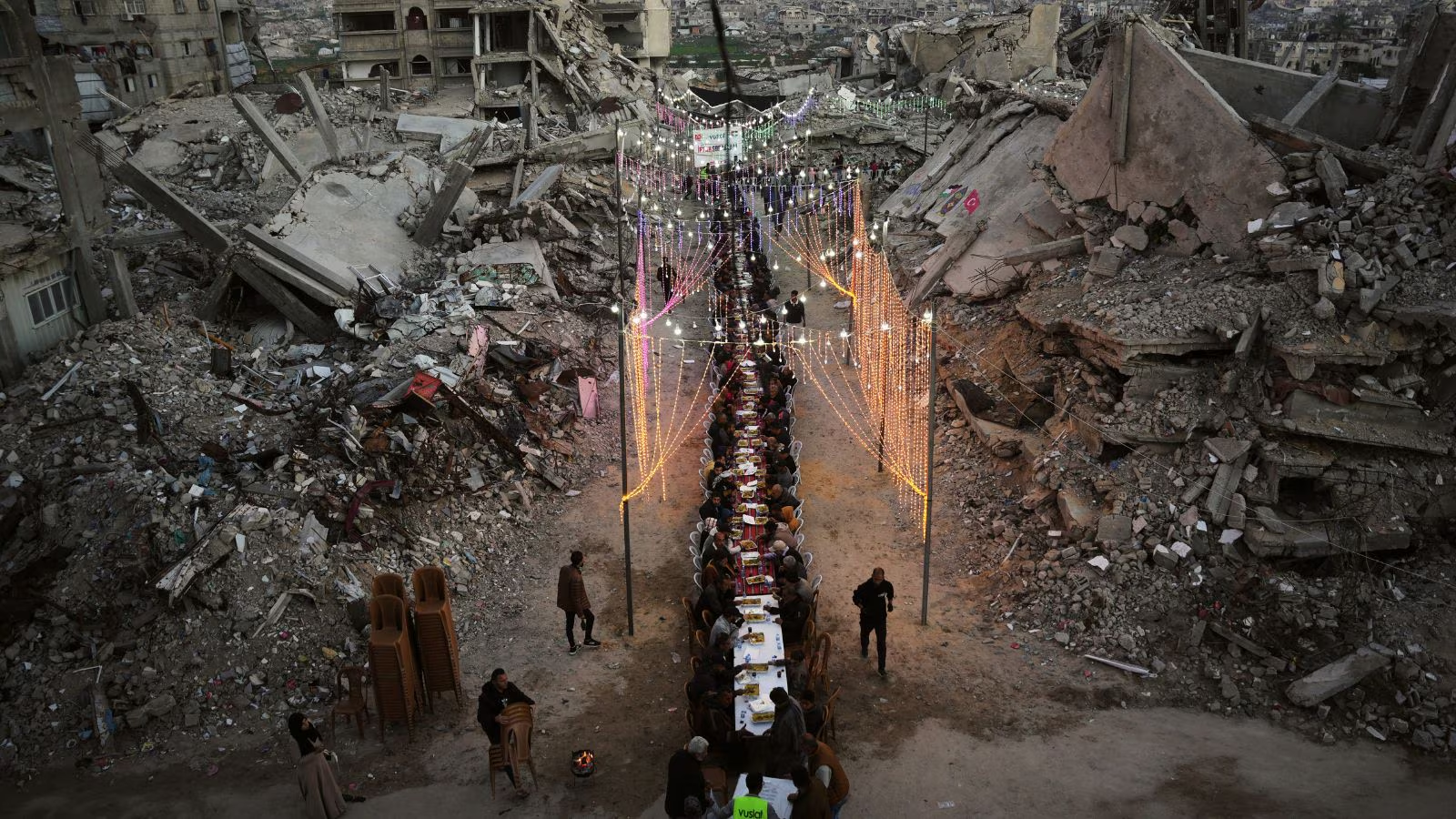
Palestinians sit at a long table amid the rubble of destroyed buildings as they gather for iftar, the fast-breaking meal, during the Muslim holy month of Ramadan in Khan Younis, Gaza Strip, Thursday, Feb. 19, 2026. (AP Photo/Abdel Kareem Hana)
At the meeting, Trump addressed those concerns, saying: “We’re going to be working with the United Nations very closely, we’re going to bring them back.”
He added that Gaza was “no longer a hotbed of radicalism and terror”.
The BBC reports that the UN is expected to contribute $2bn in humanitarian aid, while football body FIFA has pledged $75m for sports-related projects.Story continues below this ad
Why is disarmament central to the plan?
The second phase of a US-brokered ceasefire plan includes the disarmament of Hamas and reconstruction of Gaza.
Trump told participants that it “looks like” Hamas would disarm. However, there are few signs of that happening.
Hamas has publicly linked any surrendering of weapons to an Israeli withdrawal from Gaza.
Palestinians walk along a street surrounded buildings destroyed in Israeli air and ground operations during a dust storm in Gaza City. (Photo: AP)
Israeli Prime Miner Benjamin Netanyahu said Israel had “agreed with our ally the US there will be no reconstruction of Gaza before the demilitarisation of Gaza”.Story continues below this ad
The BBC notes that without disarmament, major reconstruction and governance plans cannot move forward.
How would Gaza be secured?
A key part of the proposal is creating a new Palestinian police force in Gaza.
Nickolay Mladenov, a Bulgarian politician appointed as high representative for Gaza, said recruitment had begun and “just in the first few hours we have 2,000 people who have applied”.
Both the US and Israel ins the force must not include members of Hamas-controlled police without strict vetting. It is also not expected to be made up simply of Palestinian Authority forces from the West Bank.Story continues below this ad
Under the US plan, an International Stabilisation Force would work with Israel, Egypt and the new Palestinian police to secure borders and oversee the permanent disarming of armed groups.
However, Mladenov has acknowledged there is little evidence that such a force is currently able to enforce disarmament.
What does it mean for Gaza’s future?
The war began after the Hamas-led attack on Israel on 7 October 2023, in which about 1,200 people were killed and 251 were taken hostage. Israel’s military campaign in Gaza has since killed more than 72,000 people, according to Gaza’s Hamas-run health minry.
Large parts of Gaza’s buildings and infrastructure have been destroyed.
Displaced Palestinian struggle to receive donated food for iftar, the fast-breaking meal, on the first day of the Muslim holy month of Ramadan at a community kitchen in Khan Younis, Gaza Strip, Wednesday, Feb. 18, 2026. (AP Photo/Jehad Alshrafi)
Trump’s approach combines diplomacy with investment pledges, describing it as “new thinking” aimed at resolving the conflict.
However, Mladenov has warned that without quick progress, Gaza could remain divided partly under Israeli control and partly under Hamas and separated from the West Bank. That, he suggested, would make a future independent Palestinian state difficult and fail to provide lasting security.
The success of the $7bn pledge, therefore, depends not only on funding but on whether a workable security and political agreement can be reached.