

Asha Bhosle, whose range redefined Bollywood playback singing, dies at 92 | Bollywood News
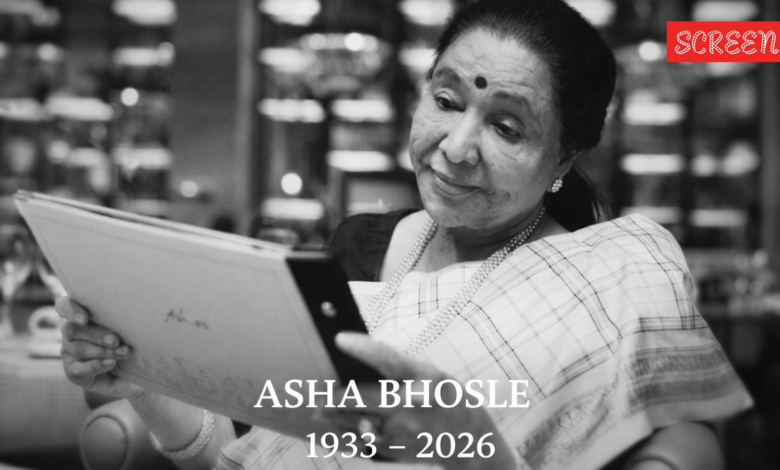

5 min readNew DelhiUpdated: Apr 12, 2026 01:55 PM From the sultry allure of a cabaret to a flirtatious number to the delicacy of a classical ghazal, with none of them ever out of place and absorbed into her voice with effortless conviction, noted playback singer Asha Bhosle, who passed away at Breach Candy Hospital in Mumbai today, leaves behind a body of work that perhaps cannot be easily categorised. She was 92.
Her son Anand Bhosle confirmed his demise to reporters outside the hospital.
Also Read – Asha Bhosle dies at 92 LIVE Updates: Celebrities pay tribute; singer’s funeral to be held on Monday
Asha Bhosle grew up in Kolhapur, where the Mangeshkar family moved from Pune after the family patriarch Dinanath Mangeshkar’s demise, so that the elder daughter, Lata, 13, could work in the robust Marathi film industry of the city. Bhosle, nine then, was fascinated English films such as Gone with the Wind (1939), For Whom the Bell Tolls (1943) and Fred Astaire films, besides the sultry voice of Portuguese-Brazilian actor and samba singer Carmen Miranda. She would come home, drape a dupatta, and sing Mama yo quiero while dancing like Miranda. “My mother thought I was crazy,” says the singer in Asha (1986).
A year after moving to Kolhapur, Bhosle made her debut in the Marathi industry at 10 with Chala chala in Majha Bal (1943). But her Hindi solo came in director Jagdish Sethi’s Raat Ki Rani (1949). The way her voice glided confidently, delicately dealing with the complicated composition Do chaar idhar, was a glimpse into what was to come in the future.
Asha Bhosle came to an exquisite film industry with some of the finest composers, filmmakers and singers joining forces, of course, to make a living, but also for the sake of high art. Even though Noor Jehan had left for Pakan after the Partition, singers such as Geeta Dutt, Shamshad Begum and, more recently, Mangeshkar had come to dominate the film industry. At this time, Bhosle would usually get the leftovers, mostly bawdy pieces picturised on the vamp, ones that were unwanted and ones where budgets were low.
Asha Bhosle dies at 92. (Photo: Express Archive)
“Back then the women characters weren’t as liberated. Therefore, through several decades, Lata Mangeshkar sang for the righteous and pure Indian woman on screen, while Asha Bhosle was the voice of the vamp or the cabaret singer. Puraane zamaane ki heroine dabi huyi thi. The romance of those days required your heroine to be coy. If you wanted a flirty or sensuous voice, you called in Asha,” said Anand ji of the legendary musical duo Kalyanji-Anandji in an interview to this reporter in 2013.Story continues below this ad
In 1953, Asha Bhosle sang for Bimal Roy’s Parineeta starring Ashok Kumar and Meena Kumari followed the song Nanhe munne bacche in Raj Kapoor’s Boot Polish (1954), and Chhod do aanchal with SD Burman (Paying Guest, 1957) which got her some attention. But it was OP Nayyar, who turned her fledgling career around with BR Chopra’s Naya Daur (1957), the Dilip Kumar-Vyjayanthimala film with man v/s machine as its theme. But what really glened was the sensuous Aayiye meherbaan (Howrah Bridge, 1958) and then there was no looking back. She sang some of her best – Ye reshmi zulfo ka, Deewana huya baadal, Jaayiye aap kahan jaayenge and songs from Kashmir Ki Kali (1964), among others, with Nayyar.
The rollicking ’70s is where Bhosle’s career got a new lease of life, with incredibly fun-to-len-to but difficult-to-render songs that only RD could have created and songs that only Bhosle could have sung. She could cry and laugh in a song, use dialogues, and play with her breath to produce some absolutely slick and sensuous cabaret pieces, such as Piya tu ab toh aaja (Caravan, 1971), the phenomenal neon-hued Duniya mein (Apna Desh, 1972), the smooth Chura liya hai tumne (Yaadon ki Baraat, 1973) that followed the clinking of the bottles, the steamy Aao na gale laga lo na (Mere Jeewan Saathi 1972), the tipsy Aao huzoor (Kismat, 1968) that had a good smattering of rhythmic hiccups and Dum maaro dum (Haré Rama Haré Krishna, 1971), a piece that became synonymous with rebellion as Zeenat Aman smoked up and sang with abandon.
Also Read – Asha Bhosle, India’s most versatile and prolific voice, is no more
In the later years, Bhosle also recorded many private ghazal albums with Ghulam Ali and Hariharan, and collaborated with US-based sarod maestro Ustad Ali Akbar Khan, under whom she began learning in 1995 as his gandabandh shagird (student for life). She kept performing till the end with abandon, crooning with much power.
Expand
Suanshu Khurana is an award-winning journal and music critic currently serving as a Senior Assant Editor at The Indian Express. She is best known for her nuanced writing on Indian culture, with a specific focus on classical music, cinema, and the arts.
Expertise & Focus Areas Khurana specializes in the intersection of culture and society. Her beat involves deep-dive reporting on:
Indian Classical Music: She is regarded as a definitive voice in documenting the lineages (Gharanas) and evolution of Hindustani classical music.
Cinema & Theatre: Her critiques extend beyond reviews to analyze the socio-political narratives within Indian cinema and theater.
Cultural Heritage: She frequently profiles legendary arts and unearths stories about India’s tangible and intangible cultural heritage.
Professional Experience At The Indian Express, Khurana is responsible for curating and writing features for the Arts and Culture pages. Her work is characterized long-form journalism that offers intimate portraits of arts and rigorous analysis of cultural trends. She has been instrumental in bringing the stories of both stalwarts and upcoming artes to the forefront of mainstream media.
Find all stories Suanshu Khurana here … Read More
Click here to follow Screen Digital on YouTube and stay updated with the latest from the world of cinema.© IE Online Media Services Pvt Ltd