Blue moon in May 2026: Why it happens and how to watch it | Technology News
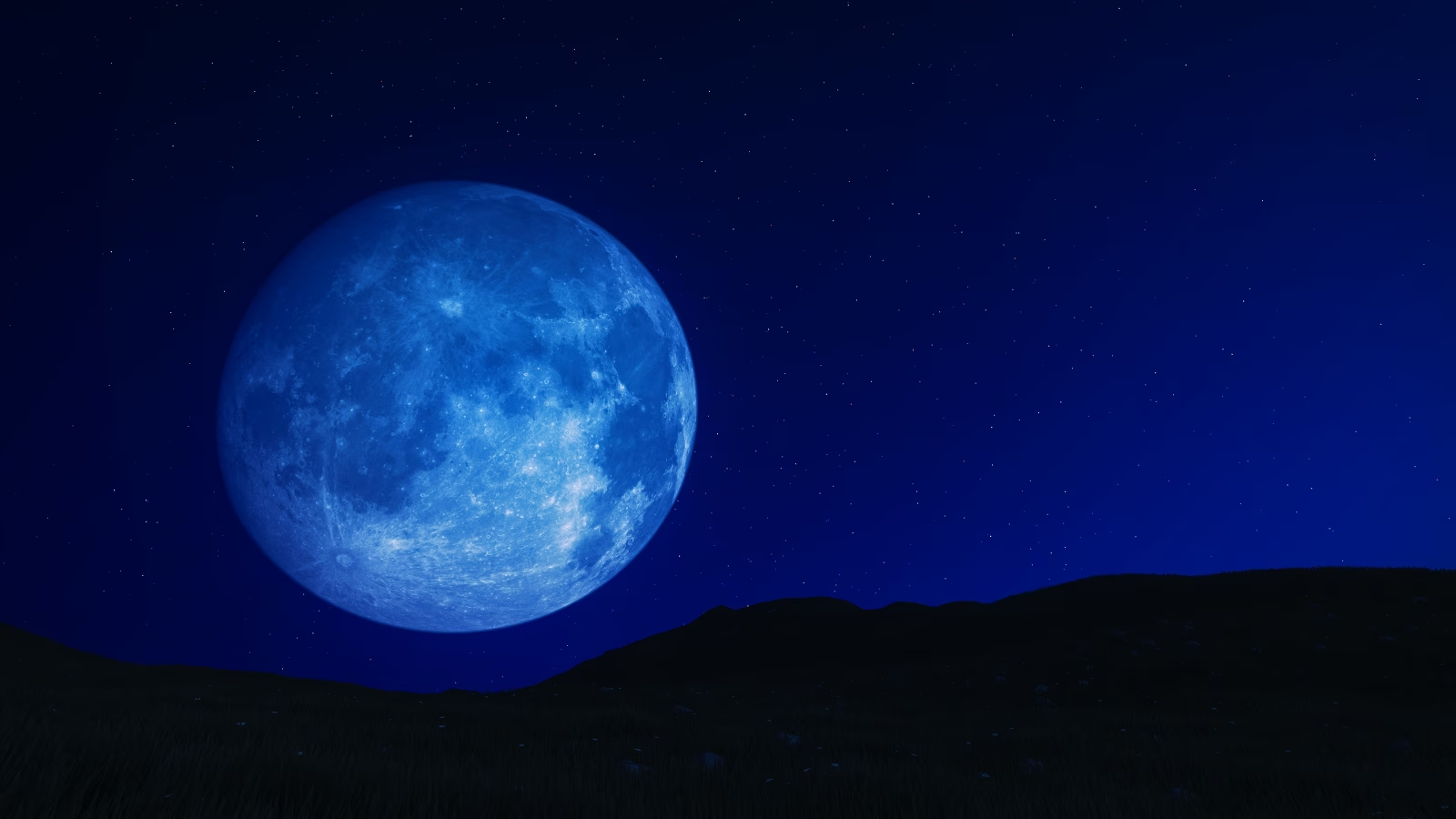

3 min readDelhiUpdated: May 21, 2026 01:48 PM We have often heard the idiom “once in a blue moon,” which means something that is vanishingly rare. But blue moons are not as rare as the idiom suggests.
On May 1, the sky offered us a full moon. Another will appear on May 31 this year, making May 2026 a genuine blue moon month.
The calendar is shaped two different cosmic cycles: the lunar cycle, based on the Moon’s orbit around the Earth, and the solar year, based on the Earth’s orbit around the Sun. The two cycles do not align perfectly. A calendar year is around 11 days longer than 12 lunar cycles.
Over time, this gap accumulates, occasionally resulting in two full moons occurring within a single calendar month. This phenomenon appears roughly every two to three years. Under the modern definition, the second of these two full moons is called a blue moon.
Two definitions The term “blue moon” has exed for centuries, but the modern definition became popular in 1946 when writer James Hugh Pruett misinterpreted old copies of the Maine Farmers’ Almanac and described a blue moon as the second full moon in a calendar month. That definition is the one most commonly used today.
The older definition is slightly different. Astronomers refer to it as a seasonal blue moon, which occurs when an astronomical season contains four full moons instead of the usual three. In that case, the third full moon of the season is called a blue moon. The next seasonal blue moon will occur on 20 May 2027.Story continues below this ad
So why call it blue?
The name “blue moon” has nothing to do with the Moon’s actual colour. Unlike white, gold, or orange moons, whose appearance depends on how moonlight travels through the Earth’s atmosphere, a blue moon is simply a calendrical term.
The longer the dance moonlight travels through the atmosphere, the more particles scatter certain wavelengths of light, affecting the Moon’s apparent colour.
When the Moon really turned blue
One of the rare occasions when the Moon genuinely appeared blue followed the Krakatoa eruption in 1883. The disaster killed more than 36,000 people, mostly due to the tsunamis it triggered.
The massive eruption sent huge quantities of smoke and dust into the atmosphere. Some particles were roughly 1 micron wide, a size capable of scattering red light while allowing blue light to pass through more easily.Story continues below this ad
For several years after the eruption, observers around the world reported seeing a bluish Moon in the night sky.
Among the widely shared modern images of a blue moon are photographs captured during the blue supermoon of August 2023 Indian photographer Soumyadeep Mukherjee in Kolkata and Taranjot Singh in Sydney.
For skywatchers in India, the blue moon on 31 May 2026 will rise in the eastern sky shortly after sunset, and it will be visible without a telescope.
(This article has been curated Seekriti Saha, who is an intern with The Indian Express)
Expand © IE Online Media Services Pvt Ltd