

‘Alien’ 3I/ATLAS hurtling towards solar system: What we know about the interstellar comet that has piqued curiosity | Technology News

A rare interstellar comet named 3I/ATLAS is hurtling through the solar system. It would give astronomers a rare glimpse of material that formed around another star. It is only the third confirmed interstellar object ever detected after ‘Oumuamua’ in 2017 and ‘Borisov’ in 2019, as per experts.
Discovered ATLAS telescope in Chile
The comet was first detected on July 1, 2025, the Asteroid Terrestrial-impact Last Alert System (ATLAS) telescope in Chile. The “3I” designation marks it as the third interstellar object ever identified, while “ATLAS” refers to the telescope that spotted it.
NASA later confirmed that the comet is following a hyperbolic orbit, meaning it is not gravitationally bound to the Sun and will leave the solar system after a brief passage.
Story continues below this ad
According to the European Space Agency (ESA), the comet will make its closest pass to Earth on December 19, coming within about 270 million kilometres, a safe dance that poses no threat to the planet.
What we know about 3I-ATLAS so far
Latest observations between October 31 and November 4 suggest that the object has shed a significant amount of mass during its encounter with the solar system. It has also shifted its path slightly, showing signs of non-gravitational acceleration, motion not caused just gravity, according to a report IFL Science.
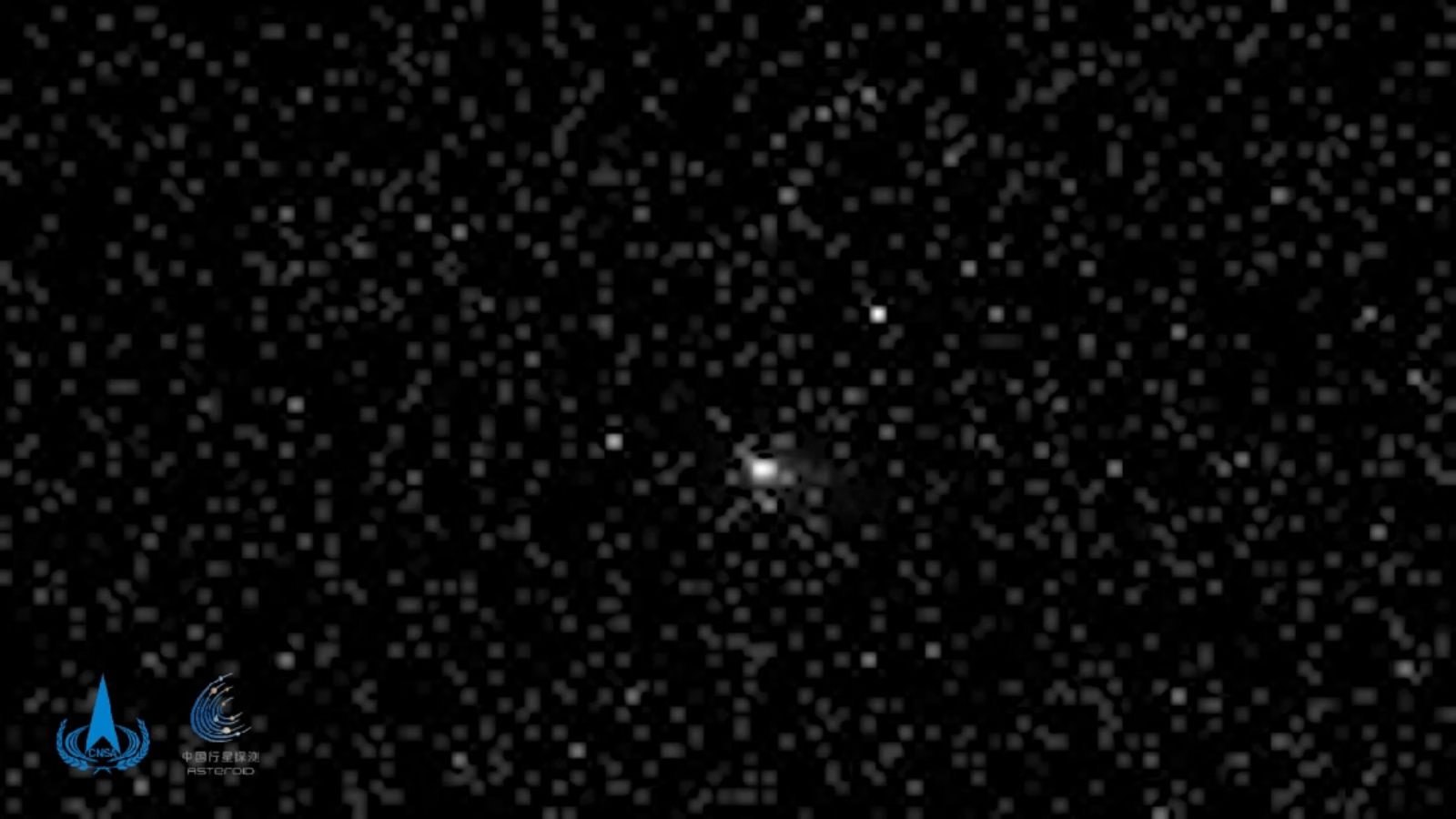
A Chinese Mars orbiter has captured rare images of the comet as it passed near the Mars on October 3, the China National Space Adminration (CNSA). The pictures were taken Tianwen-1, China’s ongoing Mars exploration mission, marking the first successful attempt to photograph such a dant and dim interstellar target.
“The Tianwen-1 orbiter successfully observed the interstellar object 3I/ATLAS using its high-resolution camera from a dance of about 30 million kilometres, one of the closest probes to do so… The images clearly show the comet’s dinctive features, consing of a nucleus and a surrounding coma, with a diameter reaching several thousand kilometers,” the CNSA said in a statement.Story continues below this ad
Nature and Composition of 3I ATLAS
Preliminary data suggests that 3I/ATLAS is an active comet composed of volatile materials similar to those found in solar system comets, but altered long-term exposure to interstellar radiation. As per NASA Planetary Science Division, early spectroscopic readings suggests the presence of carbon dioxide (CO₂) and dust emissions consent with cometary outgassing behaviour driven the Sun’s heat .
A study based on James Webb Space Telescope (JWST) observations posted to the preprint server suggested that the comet’s surface appears chemically processed, suggesting it has travelled through the interstellar medium for billions of years, where cosmic rays likely altered its outer layers.
The Hubble Space Telescope has estimated the solid nucleus of 3I/ATLAS to be no larger than 5.6 kilometres across, though the exact size remains uncertain because of the surrounding dust cloud that obscures direct measurements.
The European Space Agency (ESA) observations noted that the comet’s bright coma extends several thousand kilometres, formed continuous ejection of dust and gas as it nears the Sun.
Expand © IE Online Media Services Pvt Ltd

