

Vaibhav Suryavanshi overshadows top international batters with 35-ball ton to revive RR’s playoff chances | Ipl News
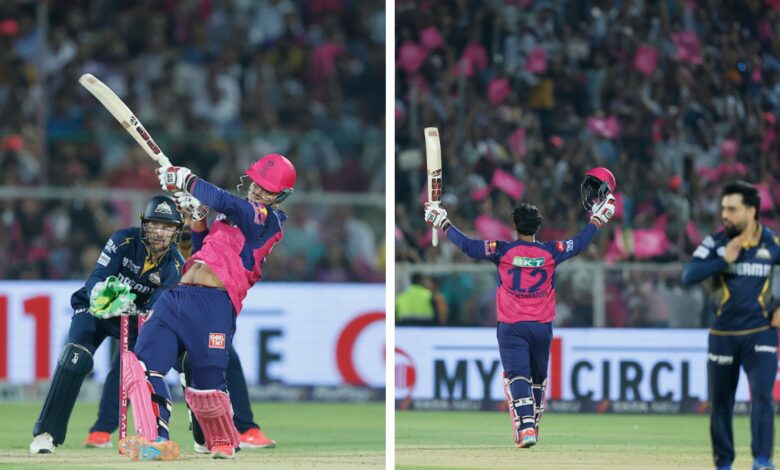

SYNOPSIS: It was a night that belonged to 14-year-old Vaibhav Suryavanshi, whose swashbuckling 38-ball 101 overshadowed the batting displays of Yashasvi Jaiswal and Shubman Gill to fire Rajasthan Royals to a dominant win.It was an evening where India’s batting talent came to the forefront across both the innings. If Shubman Gill and B Sai Sudharsan appeared to be two young blokes who want to carry forward India’s proud batting legacy that is tied to textbook shots in the classical mould, in the run chase, 14-year-old Vaibhav Suryavanshi showed what modern day T20 is all about with a century that came of 35 deliveries.
Watching it from the other end was Yashasvi Jaiswal, another special talent who is already a household name, who made an unbeaten 70 as Rajasthan Royals chased down the 210-run target that Gujarat Titans set for them with 25 balls to spare and 8 wickets in hand.
Story continues below this ad
Power and muscle
Vaibhav and Jaiswal love hitting the cricket ball. There is something about the loud thud that they love when their willow comes in contact with the ball. It gives them an adrenaline rush.
When it runs high, like it did in Jaipur on Monday, they become an irresible force, who leave even the opponents short on questions. It is what Gujarat endured when they came out with 209 runs to defend.
In his storied career, as a player and as a coach, Rahul Dravid has seen many talents. But as Suryavanshi kept sending the white-ball high into the dark skies, he would follow its trajectory with his jaws-dropped. From Mohammed Siraj to Ishant Sharma, Rashid Khan to Washington Sundar, none of the Gujarat attack was spared the teenaged Suryavanshi. Perhaps, it was the unknown package about him that made Gujarat repeatedly err bowling in the slots that the left-hander preferred. With a natural flair to hit sixes, Suryavanshi didn’t need any second invitation as runs poured. Such was the deluge of sixes and fours, that before Gujarat realised what hit them, it was all over. The onslaught of Suryavanshi was such that Jaiswal played second fiddle, remaining in the shadows to finish unbeaten on 70.
Youngest to score a T20 1⃣0⃣0⃣ ✅Fastest TATA IPL hundred an Indian ✅Second-fastest hundred in TATA IPL ✅
Vaibhav Suryavanshi, TAKE. A. BOW 🙇 ✨
Updates ▶ https://t.co/HvqSuGgTlN#TATAIPL | #RRvGT | @rajasthanroyals pic.twitter.com/sn4HjurqR6
— IndianPremierLeague (@IPL) April 28, 2025
The night belonged to Suryavanshi who batted true to his age. He wasn’t overawed the occasion and didn’t show signs of flinching when he was nearing the three-figure mark. He was on 64 off 28 balls before reaching his 100 in the next seven deliveries with a 6, 4, 6, 4, 4, 6, 6. It was his favourite pull shot, off Rashid Khan no less, that helped him reach the landmark. Balanced with his stance, he is blessed with the ability to pick the length early and if Gujarat pacers tried to intimidate the 14-year-old targeting his body, he feasted on them sending it over the ropes on 11 occasions.
Gill & Sai, the kill joy
Unlike the Rajasthan Royals duo, their counterparts Gill and Sai Sudharsan are all about flamboyance and grace. As has been the case so far, it was another outing where the duo set up the game for Gujarat with a 93-run stand which came in 10.2 overs. With a base intact, Jos Buttler walked in at No 3 to finish the job with the help of the middle-order as Gujarat put 209/4 when they seldom appeared to hit top gear. Maybe they would rue not pressing further.Story continues below this ad
Much of the damage as usual happened in the powerplay where Gill and Sai Sudharsan served a feast of the most eye-catching boundaries. The left-hander started it all in the first over with a graceful flick off Jofra Archer getting up high on his toes. Off Maheesh Theekshana, he brought out cover-drives that scorched the Sawai Man Singh surface before being offered a life Shimron Hetmyer. He would then again bring out what is turning into his trademark flicks off Archer and Theekshana. Apart from the wonderful transfer of weight from front foot to back, it was the timing that stood out in both the shots.
Gill wasn’t going to be left behind. Off three successive deliveries from Yudhvir Singh and Archer, he came up with as many boundaries with his wr work at its regal best. First up was the short-arm pull that went over mid-wicket. Then came a fore-hand pull, which soared over the mid-on fielder. And the pick of the lot came off Archer, where he stood tall and brought out a textbook straight-drive that sped to the fence as Gujarat fetched seven boundaries in the powerplay. From the seventh to 12th over, they batted on autopilot mode sans risks before Sai Sudharsan fell.
Thereafter, it was all about stamping their authority. Gill brought up his fifty from 29 deliveries and picked up his pace further as he opened up his shoulders to hit four sixes as Buttler took a bit of time to get his eye in. At 7 off 10 deliveries, the England opener began his assault going after Wanindu Hasarananga, hitting him for three sixes and a four in as many balls. From there on, despite losing Gill for 84, Buttler ensured Gujarat got a couple of big overs to finish at 209/4.
Brief Scores: Gujarat Titans 209/4 in 20 overs (GIll 84, Buttler 50) lost to Rajasthan Royals 212/2 in 15.5 overs (Suryavanshi 101, Jaiswal 70) eight wickets.
