

Are new planets being formed outside our solar system? Here’s what astronomers have found | World News
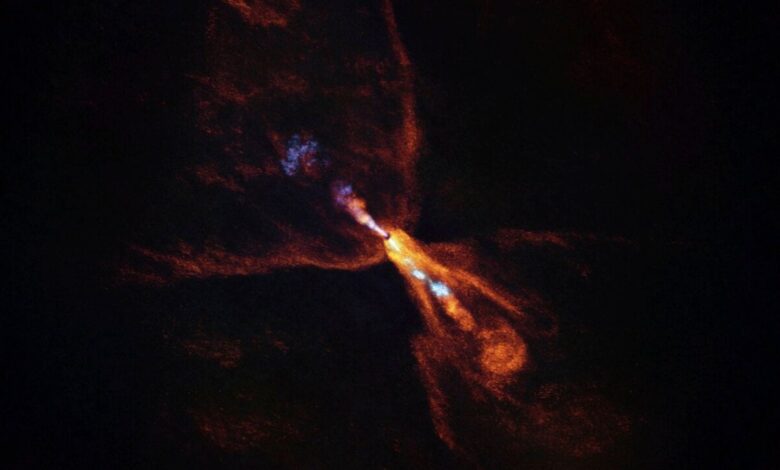

In the vast emptiness of space, some 1,370 light-years away, a faint glow pulses. Around a ba star called HOPS-315, astronomers have caught an extraordinary glimpse of a new world taking shape. For the first time, scients say, we are witnessing the very beginning of rocky planet formation around a young, sun-like protostar.
“It’s a direct glimpse of the hot region where rocky planets like Earth are born,” said Melissa McClure of Leiden Observatory in the Netherlands, as per AP, who led the international research team. “For the first time, we can conclusively say that the first steps of planet formation are happening right now.”
The findings, published Wednesday in the journal Nature, offer what McClure calls a “snapshot of time zero,” a look at the earliest phase of planetary birth.
Story continues below this ad
NASA’s James Webb Space Telescope and the European Southern Observatory’s ALMA telescope in Chile worked together to study HOPS-315, a young yellow dwarf star still in its infancy at just 100,000 to 200,000 years old. Though it’s destined to become a star like our sun, it’s currently surrounded a thick disk of gas and dust—the raw material for future planets.
Same ingredients as Earth
The researchers detected silicon monoxide gas and crystalline silicates, minerals believed to be the first solid substances to form in our own solar system more than 4.5 billion years ago. These materials were spotted in a region similar in dance to our asteroid belt, located between Mars and Jupiter.
Jets of silicon monoxide blowing away from the ba star HOPS-315. (Photo: European Southern Observatory via AP)
McClure noted that such hot mineral condensation had never been directly observed around other young stars before. “So we didn’t know if it was a universal feature of planet formation or a weird feature of our solar system,” she wrote in an email, as per AP. “Our study shows that it could be a common process during the earliest stage of planet formation.”Story continues below this ad
While previous studies have examined either younger gas disks or more mature ones where planets may already be forming, this is the first time astronomers have caught the transition phase, when the first solid particles begin to emerge.
“This is one of the things we’ve been waiting for,” said Fred Ciesla as per AP, a planetary scient at the University of Chicago, who was not involved in the study. “Astronomers have been thinking about how planetary systems form for a long period of time. There’s a rich opportunity here.”
How many planets will form?
It’s too early to tell how many planets might eventually form around HOPS-315. But McClure said that with a gas disk as massive as the one our own solar system had in its early days, the star could potentially give rise to as many as eight planets over the next million years.Story continues below this ad
Merel van ’t Hoff, a co-author from Purdue University, said the team is eager to explore more systems like this. The goal is to find out just how common the path to Earth-like worlds really is.
“Are there Earth-like planets out there,” van ’t Hoff asked as per AP, “or are we so special that we might not expect it to occur very often?”
(With inputs from AP)
