Chinese woman quits teaching job to sell coffins to Europe, earns $6 million in revenue
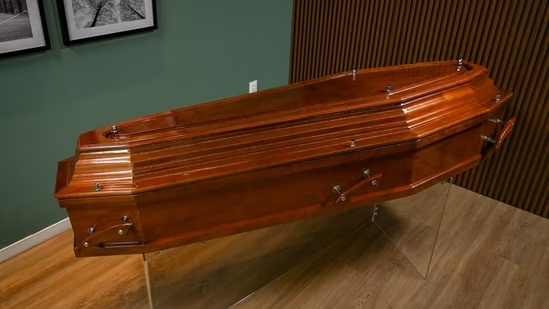

In China, death has long been regarded as a taboo subject, often associated with misfortune and bad luck. Yet in Heze, a city in eastern China’s Shandong province, that cultural hesitation has quietly given way to a thriving export business.A Chinese woman shifted careers to sell coffins abroad. (Representational image/Unsplash)According to Personage magazine cited South China Morning Post, 29 year old Lisa Liu from Heze once worked as a teacher. Strained the pressures of the classroom and left exhausted and hoarse, she made a life changing decision in July 2023. After a chance interview, Liu moved into coffin sales, focusing on the European market, particularly Italy.Her introduction to the industry was unexpected. Her boss took her on a tour of the factory, guiding her through every stage of production, from log cutting to carving and final assembly. What struck her most was the attitude of the workers. To them, a coffin was simply a wooden object. Some even used empty urns as storage boxes at home.That practical outlook helped Liu shed her own fears about coffins being “inauspicious”.A product tailored for EuropeThe coffins produced in Heze differ significantly from traditional Chinese designs. Unlike the heavy, dark coloured models common in China, Italian coffins are lighter and often decorated with religious carvings. Cultural practices also vary. In China, cremation involves only the body, while in Italy both the body and the coffin are cremated together.Heze’s natural resources give it a competitive edge. The region is reportedly home to three million paulownia trees, valued for their light weight, low ignition point and attractive grain. These qualities make the wood particularly suitable for the Italian market.According to mainland outlet Jimu News, coffins made in Heze are priced between US$90 and US$150, far lower than European products, which typically range from US$1,100 to US$2,100. Liu’s factory exports around 40,000 coffins to Europe each year, generating nearly 40 million yuan, about US$6 million, in annual revenue.Despite shifting European Union policies and rising shipping costs, Liu remains confident. “People die every day, and everyone will eventually need a coffin,” she told the media.A wider funeral economyHeze is not alone. Mibeizhuang village in Hebei province has also emerged as a hub for funeral supplies. Streets are lined with shops selling funeral clothing, flower wreaths and body bags.As reported SCMP, villagers have diversified into eco friendly offerings such as biodegradable joss paper and electronic wreaths, exporting them to Southeast Asia, Europe and the United States through e commerce platforms. China News Weekly reported that the village’s funeral supplies industry exceeded one billion yuan in annual production value in 2020.In a striking tw, some young people in the West now live stream the burning of joss paper for blessings, with stacks of paper money selling online for US$15, compared with less than 10 yuan in China.