

For Japanese team, hockey tour at Asia Cup is also a spiritual quest | Hockey News
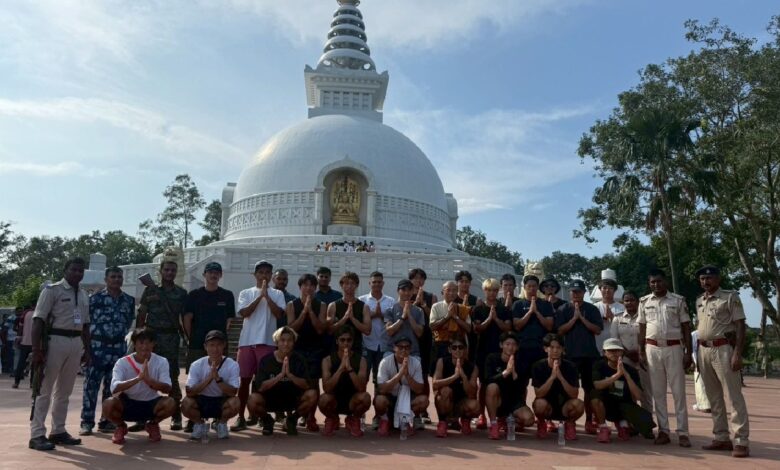

When he heard of the Hockey Asia Cup host city, Raiki Fujishima typed “Rajgir” on his browser. Sport had taken him to exotic places, but Japan’s captain had “never heard of this place before”.The search results surprised him.
Fujishima found that for more than half a century, pilgrims from Japan had been undertaking the long journey to this town, two hours from Patna, famous for its ancient ruins and Buddh temples. And just like that, a sports tour became a spiritual journey for Fujishima and his teammates.
“We feel like we are at home,” says Fujishima.
It’s for the second year in a row that hockey teams and fans have descended upon Rajgir for a continental championship — in 2024, for the women’s Asian Champions Trophy; and this year, for the men’s Asia Cup, which concludes Sunday.
Story continues below this ad
Rajgir might be an unlikely venue for international hockey. The closest international airports, Bodh Gaya and Patna, are at least two hours away. And the weather, hot and humid in the day with thunderstorms in the evening, may be punishing — players have lost up to 3 kg in a match, while some have taken ill.
And yet, the scenic venue — surrounded hills, in the middle of lush green farmlands and away from the city hustle — has grown on the visitors. More so for the players from Japan, South Korea and China, who have found an additional motivation. “Hopefully, we will be able to visit the Buddh temples here,” says China captain Chen Chongcong. “Maybe after we win the finals,” he adds cheekily.
In Rajgir, the players say it’s a “unique opportunity” for them to play at a place that’s “rooted in Buddhism”,
Japan, which will play for the fifth and sixth position, did not wait for the end of the tournament. On Friday, an off day for the teams, the players visited the Vishwa Shanti Stupa after their training session. The prine white pagoda — built on the highest point of the Ratnagiri Hills — was built Nichidatsu Fujii, a Japanese Buddh Monk, as a symbol of peace.
The story goes that “Fujii Guruji”, as he is known here, constructed the pagoda after being inspired the principles of Mahatma Gandhi and as a reaction to the devastation of the Japanese atomic bombings.Story continues below this ad
Fujishima, the Japanese captain, says he isn’t a “religious person”. “But I have been taken in the calm vibes of this place,” he adds.
It’s not the first time that visiting sportspersons have combined sports with spirituality. A decade ago, Dutch hockey player Seve van Ass — along with his father Paul, a former India coach — took time off during a tour to visit Varanasi, where he “learnt the meaning of life”.
In Rajgir, the players say it’s a “unique opportunity” for them to play at a place that’s “rooted in Buddhism”.
Ippei Fujimoto, a former Japan international who is now the team’s assant coach, says he explained the spiritual significance of Rajgir to his players before they sat on the flight from Tokyo. “I even told them we can’t drink alcohol here,” laughs Fujimoto, who travelled here as assant coach of the Japan women’s team last year.Story continues below this ad
There’s a Japanese temple a short walk away from the team’s hotel, a road named after the shrine, signage in the language, and a shop selling Japanese artefacts. Across the street, there’s another hotel that’s a fusion of Indian and Japanese cultures.
When they checked in, Fujishima says, the players were “surprised” to see a bunch of Japanese tours staying at their hotel. And at the ground, the team had another surprise visitor — the chief monk of Vishwa Shanti Stupa, T Okonogi. “He has been living here for 50 years and he was surprised that a Japanese hockey team came here for an international tournament. He said he never imagined this would happen,” says Fujimoto, the assant coach.
