

Forced to live on the street, with no clothes to wear, almost died of starvation, he became Bollywood’s most famous writer | Bollywood News

Filmmaking in India has exed for over a 100 years now. Over these decades, the industry has introduced us to countless iconic names—from the Kapoor family to legends like Madhubala and Meena Kumari, superstars such as Ashok Kumar and Rajesh Khanna, and towering figures like Dilip Kumar and Amitabh Bachchan. Yet, if you pause to notice, they are all actors. Hardly anyone beyond a niche of film enthusiats remembers who wrote the very first Indian film—or even the writer behind a recent blockbuster, be it this year’s Saiyaara or Dhurandhar.But there was one man who, along with his partner, ensured that audiences knew a film not just its stars, but its writers. That man was Javed Akhtar.
Dream to work with Guru Dutt
Born in 1945, Javed Akhtar arrived in Mumbai at the age of 19 with a singular dream—to become an assant to legendary filmmaker Guru Dutt. Fate, however, had other plans. Guru Dutt passed away within a week of Javed’s arrival, abruptly ending his dream.
Born to renowned poet Jan Nisar Akhtar and hailing from a family steeped in poetry and literature, writing came naturally to him. To survive in a city as unforgiving as Mumbai, Javed began job hunting and soon found work with filmmaker Kamal Amrohi—the husband of Meena Kumari and the director of Mahal and Pakeezah.
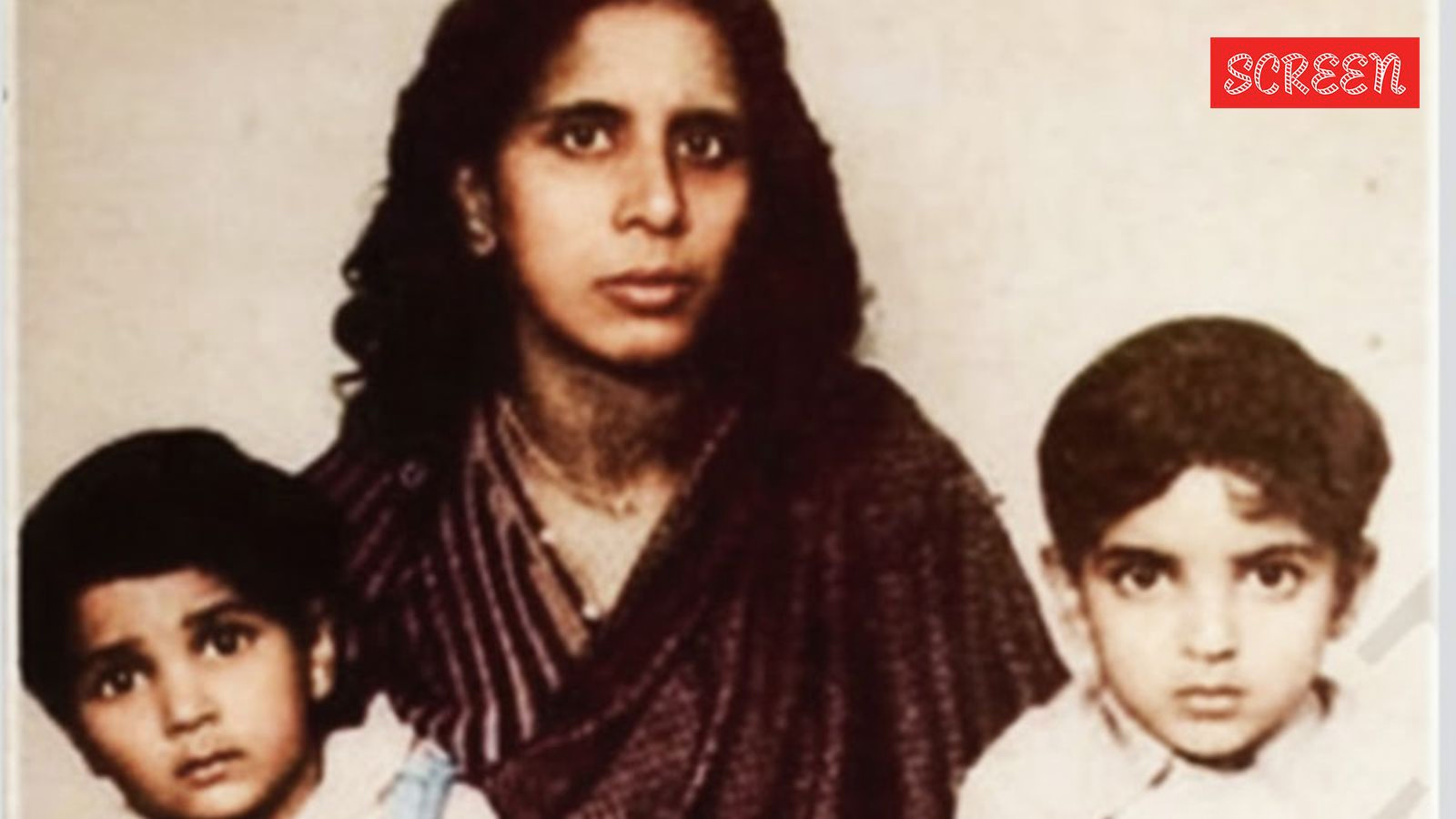
Javed Akhtar. (Photo: Express Archive)
Refused to ghostwrite
He worked there for a year, earning just Rs 50 a month. During this period, he received an offer to work as a ghostwriter for a well-known writer. Although the salary was generous, after three days of contemplation, Javed realised that a name mattered more than money. He turned down the offer—a decision that would define his life.
Also Read: Raj Kapoor once ‘hit’ Dilip Kumar on a film set, the boys from Peshawar vowed to never work together again
Javed also saw immense hardships during the struggle period but it didn’t dent his determination. Talking about his early days in Mumbai where he arrived in a third-class railway compartment, he said in the documentary Angry Young Men, “I lived with some friends, slept on railways stations, parks, studio compounds, in corridors, on benches, and so on. Some days, I’d walk all the way from Dadar to Bandra, because I didn’t have money for bus fare. Some days, it would strike me that I hadn’t eaten for two days. I would always think to myself that if one day a biography were to be written about me, this would make for an incredible moment.”Story continues below this ad
Javed Akhtar. (Photo: Express Archive)
He also spoke about facing indignities. “One day, I realised I have nothing to wear. Now, you’ll wonder how that’s possible. But that’s how it was. I had worn out my last pair of trousers, my only pair of trousers…”
He recalled moments that shaped his life. “There are two-three moments which have traumatised me very badly; that trauma has remained with me. To be hungry for two days, three days, it’s traumatic. On the third day, there is no difference between a human being and a dog. All your sense of dignity, your self respect, it becomes so vague. The only thing that you know is that you’re hungry.”
Javed Akhtar’s start in cinema
Soon after, he met S.M. Sagar, who was directing an action film titled Sarhadi Lootera. Sagar hired him as an assant for Rs 100 a month. Javed’s job was to help actors rehearse their lines. Midway through the shoot, the film’s dialogue writer quit. When Sagar asked Javed if he could take over, he replied simply, “Will try!”
ALSO READ | Sonakshi Sinha-Zaheer Iqbal’s huge house reminds Farah Khan of Mehboob Studio; has floating tv, entertainment corner, hot tub
Story continues below this ad
That attempt changed everything. Javed became the film’s dialogue writer—and it was on this very film that he met his future partner of nearly two decades, Salim Khan, who was acting in the movie. Though Sarhadi Lootera failed at the box office, it marked the birth of what would become the most horic writer duo in Indian cinema. Success, however, was still a dant dream.
After writing a script for S.M. Sagar for an Ashok Kumar film, Salim-Javed earned a respectable Rs 5,000. What they didn’t receive was credit. Disillusioned, they turned to G.P. Sippy.
The birth of Salim-Javed
Around the same time, a young Ramesh Sippy was keen on setting up a writing department in his father’s production house. Salim-Javed approached him with a story. Initially reluctant, Ramesh Sippy soon found himself completely drawn in—and the end of the narration, he hired them both for Rs 750 a month.
Javed Akhtar. (Photo: Express Archive)
Their first film with Sippy Films was Andaz. Even before its release, many in the industry had written it off as a failure, largely because its hero, Rajesh Khanna, dies at the very beginning. Defying all predictions, Andaz went on to become a blockbuster.Story continues below this ad
Yet again, despite the story being a Salim-Javed original, they were denied proper credit and were led merely under the Sippy Films Story Department.
Collaboration with Rajesh Khanna
Unwilling to accept this, the duo aligned with Rajesh Khanna. At the time, the superstar had signed a Hindi remake of the Tamil film Deiva Cheyal. Unhappy with the original script, Rajesh Khanna asked Salim-Javed to rewrite it, promising them full credit. The result was the 1971 hit Haathi Mere Saathi.
The film succeeded, but the promise wasn’t kept. Salim-Javed were paid only Rs 10,000, and the experience strained their relationship with Khanna. Around the same period, they also wrote Seeta Aur Geeta, another massive hit. Yet again, the screenplay credit went to Sippy Films.
Salim-Javed finally took credit
Disheartened but determined, Salim-Javed wrote Zanjeer. Director Prakash Mehra took the script to several established stars, including Dilip Kumar and Raj Kumar. It was Salim-Javed who insed that the film be made with a then-rising Amitabh Bachchan.Story continues below this ad
Zanjeer released and changed the course of Hindi cinema. The duo earned Rs 55,000 for the story—but their names were still missing from the posters.
This time, they took matters into their own hands. They hired a painter and had their names written boldly across the posters, shocking the industry and rewriting the rules of recognition.
What followed was hory. Films like Deewar, Trishul, and Sholay didn’t just succeed—they redefined Indian cinema. To this day, their dialogues echo across generations.
The partnership ended in 1982, but the legacy never faded. As Sholay completes a grand 50 years, Salim-Javed’s contribution continues to remind us that stars may shine on screen, but it is writers who build worlds that last forever.