How matcha, kunafa chocolate, and ‘ugly-cute’ toys defined cool in 2025 | Lifestyle News
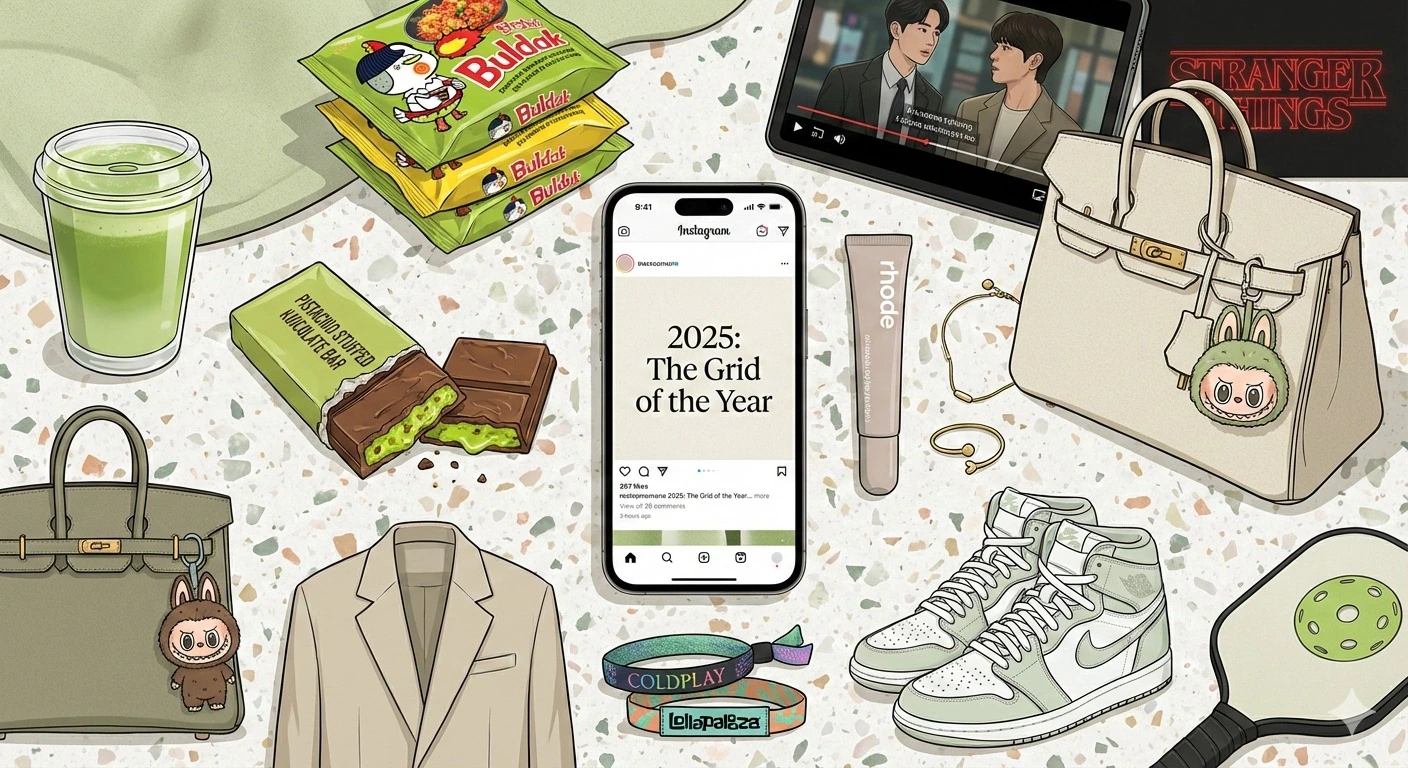

Radioactive green matcha lattes. “Ugly-cute” Labubu monster charms clipped onto luxury handbags. Pachio-stuffed kunafa chocolate bars. K-dramas and Stranger Things reruns. Buldak fire noodles stacked in kitchen cupboards. Rhode lip balm, minimal jewellery, oversised clothing, Coldplay and Lollapalooza concert wrbands, pickleball racquets, and unworn Jordans proudly displayed on wardrobe shelves.In 2025, these objects formed the Instagram grid of the year: a repeating visual code that signalled a discerning taste for all the ‘good things’ in life.They were instant markers, read differently different audiences. To some, they suggested membership in a global elite with refined taste, to others, fluency in the algorithm, and a life calibrated to look aspirational on the grid. They signalled taste, access, mobility, and the right alignment with the zeitge.In 2025, green tea, quite literally, appeared beside laptops and aesthetically positioned books in cafés. Iced, verdant beverages in see-through tumblers were carried through the glass doors of Pilates studios, set on terrazzo counters at sunset, and carefully framed in mirror selfies. This was matchaWith its origins as ceremonial Japanese tea, matcha entered Western wellness culture in the 2010s, then expanded across café menus worldwide. 2025, it had evolved from a beverage to a visual symbol of discipline, health, and discerning taste, its popularity so explosive that global demand placed a visible strain on its supply, driving up its price.
“There has been a shift in how refinement and taste are being signalled,” says Rahul Advani, a cultural anthropolog with a PhD from King’s College London. “For a long time, good taste was associated with looking more refined and polished.” Premium coffee, he explained, had once carried that burden of dinction. “Matcha unsettled that order.”
If matcha was the disciplined end of the spectrum, the kunafa chocolate represented the opposite. It was indulgence engineered for spectacle.Story continues below this ad
Created in 2021 the Dubai-based boutique chocolatier FIX under the name Can’t Get Knafeh of It, the chocolate bar remained a novelty for nearly two years. Then, in December 2023, a TikTok video showing its bright green filling and theatrical break-apart texture sent it ricocheting across the platform. 2025, demand had travelled across the globe. Global brands, including Lindt, released their own versions, smaller chocolatiers worldwide sold copycats as “Dubai chocolate,” and pachio prices surged amid reports of supply strain linked to the trend.
the time the bar reached homes on scale, it arrived as proof: of travel, of access, of proximity to something that had briefly been difficult to obtain. It appeared on coffee tables after airport returns, was broken into uneven squares during family visits, and was photographed before anyone reached for a piece.
The doll that ate the algorithm
If matcha and kunafa performed taste through consumption, Labubu performed it through attachment.
Originally a mischievous character created Hong Kong illustrator Kasing Lung, Labubu entered mass circulation through the blind-box economy of POP MART. This Chinese collectibles giant turned surprise purchases into a global retail addiction. 2025, Labubu had slipped its toy store origins and hardened into a worldwide status object, clipped to Hermès, Balenciaga, and Coach bags in Seoul, Shanghai, New York, Dubai, and Mumbai alike.Story continues below this ad
Labubu drops caused queues outside malls across East and Southeast Asia. Resale prices spiked online. Influencers staged unboxing videos with the same care once reserved for sneakers and handbags.
For Basarat Hassan, Assant Professor in the Department of Epemology at Jain University, Bangalore, this was part of the same visual reorganisation that had propelled matcha and kunafa. “These are childish, not even conventionally good-looking,” he said. “But they became a marker of good taste. If you were wealthy enough, then you had these Labubus attached to your purse.”
What Labubu offered was elite detachment without abandoning elite access. The bag might cost six figures. The charm announced that its owner was in on the joke. The doll, unlike Barbie, did not need to be loved, it only needed to be seen.
This circulation helped proliferate taste across classes. As Dr Mangla Bhardwaj, Assant Professor at UILAH, Chandigarh University, out it, “Taste operates as an economy of copies, where cultural capital is performed through imitation — people buy not the object itself, but the symbolism attached to elite taste.”Story continues below this ad
Novelty and power
For Hassan, what links matcha, kunafa, and Labubu is novelty and power. “There is already a long philosophical debate around taste,” he said, referring to Pierre Bourdieu. “If we redefine Bourdieu in contemporary times, we can say that the tongue itself is a site of power. Food is not about taste alone. It is about ears and vision also. It is about the entire sensory experience.”
2025, he argued, food had stopped functioning primarily as nourishment. “Food today is not about health, it is not about hygiene, it is not about intellect. It’s more about aesthetics.” That aestheticisation, he said, was not incidental. “The entire global consumption market is being driven this idea.”
“Aesthetics is a new taste,” he said.
Taste, in 2025, operates as a theatre of approximation, near enough to resemble, never enough to belong.
What else was cool in 2025
2025, K-pop and K-dramas had shifted from niche obsession to ambient culture. For Priyanka Nayak, now 18 and studying computer science in Hyderabad, it started early. “I was 12 when I began watching,” she said. “It wasn’t about being cool. I was impressed the performances.” She picked up “entry-level Korean,” and adulthood, K-culture felt routine. “Nobody is surprised if you follow it.”Story continues below this ad
For Saina Singh, cool in 2025 tasted Korean. “Sushi, anime, K-dramas — I was eating ramen every day,” she said. Soon, the city sprouted Korean eateries; menus changed; skincare routines moved from YouTube to bathroom shelves.
then, the grammar of cool was stable enough to be recited on demand. Priyanka led it easily: “Labubu dolls, Rhode lip balm, matcha, minimal jewellery, oversized clothing, Pilates classes, skin-care routines,” she said, before laughing at herself. “We are probably the best at feeling rich mentally, if you know what I mean.” The aesthetic offered the illusion of access even when money lagged behind desire.
The grid did not merely aestheticise beauty, it aestheticised discipline.