‘I was really offended, but then…’: R Madhavan recalls when his wife noticed the unhappiness that prompted him to take a 4-year career break; how career disillusionment shows up | Workplace News
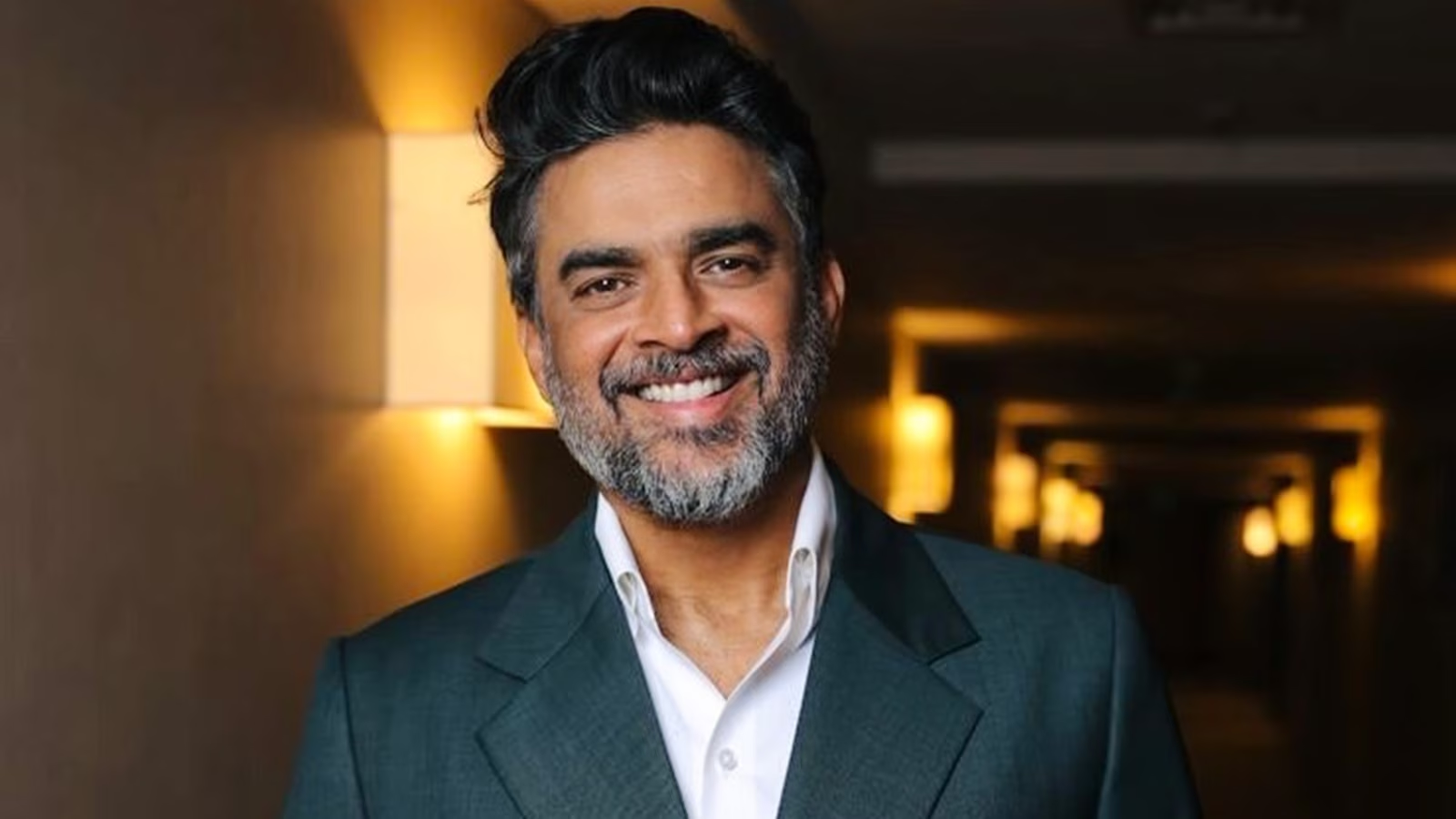

Many professionals reach a point in their careers where success at work does not match inner satisfaction. Long hours, repetitive roles and the pressure to meet expectations can leave them feeling disconnected. Actor R Madhavan recently reflected on a similar phase in his own career while speaking on Unfiltered Entertainment’s YouTube talk show. Ahead of his upcoming film Dhurandhar: The Revenge, he spoke about taking a four-year break before Saala Khadoos in 2016. He explained, “I had to take a break because I was very disillusioned with the kind of work I was doing. I was shooting in Switzerland with orange pants and a green shirt for a Tamil song. I was in the middle of the road, and I saw this Swiss farmer sitting there, looking at us with complete disdain. Sipping a cup of tea and thinking of what we were doing. I looked at him and thought you come to Chennai and I’ll show you who I am.”
The actor continued, “I was really offended, but then it struck me suddenly. I am literally dancing to other people’s tunes. I am a public speaker, I know how to handle a gun, fly remote planes, and ride horses. I do so many things. I am showing none of it in my movies. The only thing I was trying to do was to woo the audience, which would make me a superstar. I realised the make I was making (sic).”
He also spoke about how his wife noticed his growing unhappiness. “One day, my wife asked me, ‘What’s wrong with you?’ She said that you are going to work like you want to come back from it. That actually made a lot of sense. So, I took a break. I wanted to understand where the country was going. I even stopped doing ad films, grew a beard, and travelled a lot around Chennai and other places in India. I talked to rickshaw guys, what really matters to them, what’s the real cost of stuff that bothers them. That insight for four years is probably what I’m eating off right now (sic).”
He added that after his break, he realised the directors he had been working with were not as forward-thinking as he was, which led him to seek new collaborators. He eventually returned to work with a different approach, delivering several critically acclaimed performances.
Psychological signs of becoming deeply disengaged or disillusioned with work
Dr Sakshi Mandhyan, psycholog and founder at Mandhyan Care, tells , “I usually see disillusionment show up as emotional flattening rather than exhaustion. Burnout feels loud. There is fatigue, irritability, and a wish for rest. Disillusionment feels quieter. People stop caring. The work no longer feels meaningful even after time off.”
R Madhavan with his wife Sarita Burje (Source: Instagram/R Madhavan)
Psychologically, she says, this refers to “value incongruence.” The person’s effort no longer aligns with their inner motivation. The usual visible signs are cynicism, detachment, and a sense of performing rather than participating. Stress improves with recovery. Disillusionment does not.
Another marker is identity strain. People say they feel like they are playing a role instead of expressing themselves. Dr Mandhyan states, “When motivation does not return after rest and emotional dance keeps growing, it is usually not temporary burnout. It is a deeper signal that something essential is misaligned.”Story continues below this ad
How taking a career break influences clarity, motivation, and long-term satisfaction
Dr Mandhyan mentions that a career break “can be restorative when it allows psychological decompression. I explain this as giving the nervous system space to reset. Constant performance keeps the brain in a survival loop. Stepping away reduces cognitive overload and emotional reactivity.”
Clarity emerges when the break is intentional. “Reflection, routine, and some structure matter. Without that, breaks can increase anxiety rather than insight. Motivation only returns when people reconnect with intrinsic goals instead of external demands,” stresses Dr Mandhyan.
Steps to take to realign one’s career with values and strengths
Dr Mandhyan notes, “A practical first step is values clarification. Naming what feels missing restores cognitive clarity. Next comes skill mapping. I encourage people to l what they are good at and what energises them. This supports self-efficacy and reduces impulsivity. Small experiments help.”
Journaling or therapy helps separate frustration from deeper dissatisfaction. “Realignment works best when decisions come from awareness rather than exhaustion. When people act from a position of clarity, the change feels grounded instead of reactive,” concludes Dr Mandhyan.