

Unmanned cameras, delayed broadcast, heart-rate monitors: The present and future of chess broadcast | Chess News
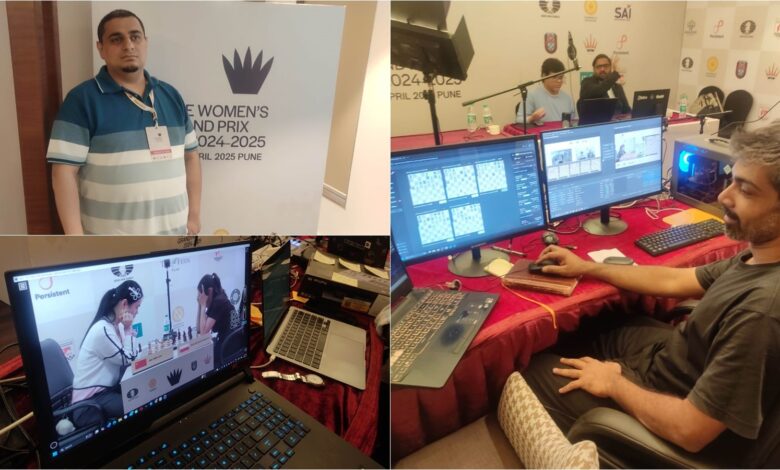

Manu Gurtu brles if you call chess a ‘game’, and not a ‘sport’. Originally a techie, he was hooked to the checks “before chess became cool” and spent the Covid lockdown convincing his classmate and now business partner Sreekar Channapragada that chess is indeed a sport. Together they have now taken over the responsibility of providing world-class broadcast feed of the sport from India to the world.At the FIDE Women’s Grand Prix, it involves 15 unmanned cameras in the playing rooms on a separate floor from where just two cable wires dangle, with all the maneuvering remote-controlled.
“Of the two wires, one is actually a back-up. So all chess broadcast input is essentially 15 cameras, one wire,” Manu says of the unintrusive set-up where clarity is essential but even 60 frames-per-second suffice. “Unlike other sports, chess isn’t fast at all. Most times, it’s players sitting with hands on head. It is literally just two people thinking so the challenge for the commentators is to dumb it down just enough, but keep energy levels high while educating.”
Story continues below this ad
India is entering its golden age of chess with a men’s world champion, several challengers still to hit their prime, and a women’s team that won the Olympiad. “So the broadcast quality needed to match up,” says Manu, whose Hyderabad-based company also manages a bunch of top names, and organised the Chennai Grandmasters meet last year that helped Gukesh qualify for the Candidates.
When camerapersons shot chess in earlier years, they still followed protocols, but the unmanned equipment has brought Indian broadcast up to top international standards.
“Chess broadcast equipment is completely different from other sports. Cameras are mounted on tripods and we can pan, tilt and zoom remotely with minimal movement so it doesn’t durb players at all,” Manu says.
Chess came with its super-sensitive mandates – cameras couldn’t make noise, can’t have light flash on players’ faces, not more than 450 lumens on the board. And the strict 15-minute delay in broadcast as an anti-cheating measure. While all broadcasts revolved around player comfort, Manu strikes a variant chord on the 15-minute delay, where stored footage is pushed after sufficient lag. “I understand their reasons. But as a live producer, I’d not want the delay,” he says.Story continues below this ad
Be innovative
Commentator Rakesh Kulkarni, an International Master himself, says it is a challenge when chat-groups following live are fed delayed assessments.
“Compared to other live streams, we appear not to be in sync, but the 15-minute delay is a fairplay measure so nothing can be done,” he says.
Adding more polls on most-interesting-matches is a ploy to keep viewers hooked, even though there’s considerable excitement as Dronavalli Harika and Koneru Humpy square off in classical chess after 21 years.
“It’s been a brilliant experience because the first three rounds saw decisive results, and it’s fighting chess among women. Men have more draws. The average is 70 percent wins in women vs 70 percent draws in men. It’s more enjoyable, more action in knockouts because people love to see bloodshed,” Kulkarni says about the ongoing event.Story continues below this ad
While admitting that a sense of paranoia has percolated into chess with anti-cheating walls up, Manu says reasons for being suspicious are legitimate.
“Cheating definitely happens, and as computing and AI becomes smaller and smaller, it’s a bigger challenge. But as a broadcaster, I can tell you that cheating isn’t just accessing each and every move. It can even be someone indicating with a thumbs up that a position played is strong, validating the line,” he says.
Broadcasters can provide feed to arbiters, but it’s not so much their headache. “The best way would be to isolate players like in the World Championship, so they can’t see outside, but viewers can look in.”
Still, several ticklish issues are confronted each day in chess broadcasts. Heart-rate monitors is something broadcasters would love to become more common, but players are uncomfortable sharing data given it can reveal details of weaknesses. For organisers, it’s a third headache – they don’t want any electronic equipment strapped onto players, given how metal detectors, radio-frequency scanners and a generous dose of scepticism are all pervasive to stop these invisible signals. “Frankly any sport will grow in viewership only if players accept change, so it’ll be nice if we have heart-rate monitors,” Manu says.Story continues below this ad
Be observant
But broadcasters don’t just pick on cues that raise anti-cheating antennae. “Like if a player keeps looking repeatedly at one spot which can be flagged,” he says. The producer’s interest is largely in the typical tics noticed in players, which make broadcast fun.
“When Harika is focused and stressed, she has hands on head. But if she’s sitting straight, the game is under her control. ® Praggnanandhaa sips water when relaxed. If (D) Gukesh is absolutely sure, he starts walking about. Levon Aronian forms a hand knot behind his back and the stretch is particularly indicative of a certain frame of mind. But a lot of players train in not giving away any cues. Iceman (Arjun) Erigaisi works on his poker,” Manu says. “Some literally start shaking, others don’t want opponents to notice.”
It might’ve thrown chess into constant flux, but Manu reckons Hans Niemann and Magnus Carlsen and their beef has been good for the sport. “Carlsen is a character and outspoken. But I’d be lying if I said Niemann isn’t good for chess. Their feud did bring a certain amount of excitement. Chess was all gentlemanly (in facade), but Niemann brought the eyeballs and ‘masala’, as they say. Streamers too have made chess popular.”
01Broadcast nibblesDGT electronic boards have sensors. So when player makes move, it gets on broadcast naturally without a human making it for broadcast.
And at events like Candidates, they had cameras next to board. Like a pawns eye view where it looks at the player and tries to trace the way their eye is moving to try and guage their thought process
All the video is produced and commentated upon, on another floor, and FIDE tournaments get followed in over 100 countries, even as broadcasters walk the tightrope in this unique sport where players can’t be durbed but viewers need to be kept hooked. The three camera angles focus on expression, full frame, and on the board pieces.
Story continues below this ad
“Chess is played out in the head and we can’t look inside the mind. We try to ensure viewers experience what it is exactly. Commentators do well to keep up energy levels, and fill in spaces when players just think. But it’ll be important for them to keep it light, have fun and banter and not go too deep. Maybe show a move rather than say Knight to c3. A lot of innovation is still needed,” Manu signs off.

