Iran’s president orders country to suspend cooperation with UN nuclear watchdog IAEA | World News
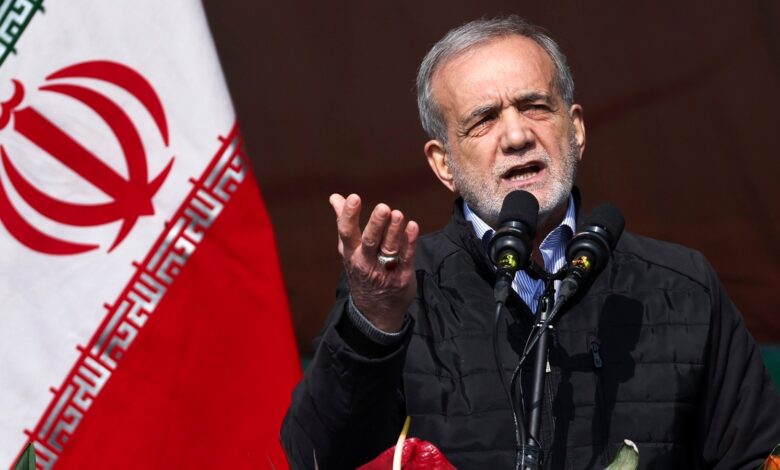

Iran’s president on Wednesday ordered the country to suspend its cooperation with the International Atomic Energy Agency after American and Israeli airstrikes hit its most-important nuclear facilities, likely further limiting inspectors’ ability to track Tehran’s program that had been enriching uranium to near weapons-grade levels.The order President Masoud Pezeshkian included no timetables or details about what that suspension would entail. Iranian Foreign Miner Abbas Araghchi signaled in a CBS News interview that Tehran still would be willing to continue negotiations with the United States.
“I don’t think negotiations will restart as quickly as that,” Araghchi said, referring to U.S. President Donald Trump’s comments that talks could start as early as this week. However, he added: “The doors of diplomacy will never slam shut.”
Story continues below this ad
Pressure tactic
Iran has limited IAEA inspections in the past as a pressure tactic in negotiating with the West — though as of right now Tehran has denied that there’s any immediate plans to resume talks with the United States that had been upended the 12-day Iran-Israel war.
Iranian state television announced Pezeshkian’s order, which followed a law passed Iran’s parliament to suspend that cooperation. The bill already received the approval of Iran’s constitutional watchdog, the Guardian Council, on Thursday, and likely the support of the country’s Supreme National Security Council, which Pezeshkian chairs.
“The government is mandated to immediately suspend all cooperation with the International Atomic Energy Agency under the Treaty on the Nonproliferation of Nuclear Weapons and its related Safeguards Agreement,” state television quoted the bill as saying. “This suspension will remain in effect until certain conditions are met, including the guaranteed security of nuclear facilities and scients.”
It wasn’t immediately clear what that would mean for the Vienna-based IAEA, the United Nations’ nuclear watchdog. The agency long has monitored Iran’s nuclear program and said that it was waiting for an official communication from Iran on what the suspension meant.Story continues below this ad
A diplomat with knowledge of IAEA operations, who spoke on condition of anonymity to discuss the situation in Iran, said that IAEA inspectors were still there after the announcement and hadn’t been told the government to leave.
Israel condemns the move
Iran’s decision drew an immediate condemnation from Israeli Foreign Miner Gideon Saar.
“Iran has just issued a scandalous announcement about suspending its cooperation with the IAEA,” he said in an X post. “This is a complete renunciation of all its international nuclear obligations and commitments.”
Saar urged European nations that were part of Iran’s 2015 nuclear deal to implement its so-called snapback clause. That would reimpose all U.N. sanctions on it originally lifted Tehran’s nuclear deal with world powers, if one of its Western parties declares the Islamic Republic is out of compliance with it.Story continues below this ad
Israel is widely believed to be the only nuclear-armed state in the Middle East, and the IAEA doesn’t have access to its weapons-related facilities.
Iran’s decision stops short of experts’ worst fears
Iran’s move so far stops short of what experts feared the most. They had been concerned that Tehran, in response to the war, could decide to fully end its cooperation with the IAEA, abandon the Nuclear Nonproliferation Treaty and rush toward a bomb. That treaty has countries agree not to build or obtain nuclear weapons and allows the IAEA to conduct inspections to verify that countries correctly declared their programs.
Iran’s 2015 nuclear deal allowed Iran to enrich uranium to 3.67% — enough to fuel a nuclear power plant, but far below the threshold of 90% needed for weapons-grade uranium. It also drastically reduced Iran’s stockpile of uranium, limited its use of centrifuges and relied on the IAEA to oversee Tehran’s compliance through additional oversight. The IAEA served as the main assessor of Iran’s commitment to the deal.
But Trump, in his first term in 2018, unilaterally withdrew Washington from the accord, insing it wasn’t tough enough and didn’t address Iran’s missile program or its support for militant groups in the wider Middle East. That set in motion years of tensions, including attacks at sea and on land.Story continues below this ad
Iran had been enriching up to 60%, a short, technical step away from weapons-grade levels. It also has enough of a stockpile to build multiple nuclear bombs, should it choose to do so. Iran has long insed its nuclear program is for peaceful purposes, but the IAEA, Western intelligence agencies and others say Tehran had an organized weapons program up until 2003.
Suspension comes after Israel, US airstrikes
Israeli airstrikes, which began June 13, decimated the upper ranks of Iran’s powerful Revolutionary Guard and targeted its arsenal of ballic missiles. The strikes also hit Iran’s nuclear sites, which Israel claimed put Tehran within reach of a nuclear weapon.
Iran has said the Israeli attacks killed 935 “Iranian citizens,” including 38 children and 102 women. However, Iran has a long hory of offering lower death counts around unrest over political considerations.
The Washington-based Human Rights Activs group, which has provided detailed casualty figures from multiple rounds of unrest in Iran, has put the death toll at 1,190 people killed, including 436 civilians and 435 security force members. The attacks wounded another 4,475 people, the group said.Story continues below this ad
Meanwhile, it appears that Iranian officials now are assessing the damage done the American strikes conducted on the three nuclear sites on June 22, including those at Fordo, a site built under a mountain about 100 kilometers (60 miles) southwest of Tehran.
Satellite images from Planet Labs PBC analyzed The Associated Press show Iranian officials at Fordo on Monday likely examining the damage caused American bunker busters. Trucks could be seen in the images, as well as at least one crane and an excavator at tunnels on the site. That corresponded to images shot Sunday Maxar Technologies similarly showing the ongoing work.