
Japanese man who lost his Bengaluru business due to AI starts toy brand in Madurai: ‘Extreme difficulties’
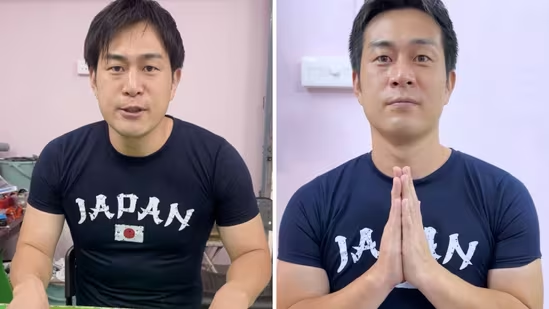

Futoshi Ito’s journey in India is a story of resilience in the face of the AI revolution. Originally, the Japanese entrepreneur moved to Bengaluru to run a tech business. However, as Artificial Intelligence began to transform the tech landscape, Ito realised his business model was no longer sustainable. “After AI came, our business was at an end,” he told HT.com. Rather than leaving the country, he pivoted entirely, moving from the tech hubs of Karnataka to Madurai, Tamil Nadu, to start a toy brand called RigWheels.The Japanese man who started a second business in India after losing his first one due to AI. (Futoshi Ito)Now, Ito is applying Japanese precision to the Indian manufacturing landscape. Based in Madurai, he has dedicated himself to creating toys that Indian parents can trust, with a particular focus on his popular Vande Bharat toy train models. In a conversation with HT.com, he opened up about the shutdown of his tech startup, the birth of his toy brand, and the challenges of running a business in India.Also Read: ‘This is my life in a small Pakani colony’: American shares glimpse of her life married to a localThe pivot: From coding to toy makingIto, who studied sports science at Waseda University, Japan, initially believed that Bengaluru was the place to be. But when his company faced the AI onslaught, he chose to restart. He teamed up with entrepreneur Saravana Bhava, now RigWheels’ COO, to build something physical.“I believe India has big potential to build strong global brands,” Ito told HT.com. Despite the end of his first venture, his faith in the “Made in India” dream remained unshaken.Recalling his first startup, he said, “We started our business from cooding boot camp. But After AI come, our business was end. So now We restart to make new business.” He added that the first company was in Bengaluru.How was it to start your business in India?Ito recalled, “To be honest, it has been extremely challenging.” He discussed how tough it was to navigate the starkly different work cultures in Japan and India.“I struggled greatly with the differences in work culture. Since I was not born or raised in India, I often felt the cultural gap very strongly. In Japan, work is expected to be done quickly and with refinement. Punctuality is taken very seriously, and delivering high-quality results the deadline is considered essential,” Ito told HT.com.He added, “In India, however, something tends to go wrong almost every day. The reasons vary widely. Even within the workplace, I had to build discipline from zero. I needed to establish structure, standards, and expectations from the ground up. I was also surprised how quickly employees changed jobs after being trained. In Japan, senior employees typically spend two to three years training new graduates until they become fully independent professionals.”Despite the challenges, he said he and his business partner managed to “create an excellent product.”He explained that he feels India doesn’t lack technical capability or talent, but that there are challenges with infrastructure. “What I want to emphasize is this: it is not that India lacks technical capability. The talent and potential absolutely ex. The challenge lies more in systems, standards, and alignment — not in intelligence or ability.”How is life in India?When asked about the differences between India and his home country, Ito candidly shared both the positives and negatives.“Japan is one of the safest and most well-developed countries in the world. The infrastructure is highly organized, and wherever you go, life is comfortable and convenient. In many ways, it is an ‘easy’ country to live in,” he told HT.com,“For me, India has been extremely challenging. I have lived in India for eight years. In the beginning, even eating local food caused stomach problems almost every day. Over time, however, I found my own ways to manage and control it.”He recalled, “I have learned through repeated trial and error. Especially in terms of physical and mental health, I have had to develop my own systems and habits to stay balanced.”Also Read: Foreign traveller’s honest take on India’s culture and stereotypes goes viral: ‘It’s not wrong, it’s just different’Life in India required a total lifestyle overhaul for Ito. “I like drinking alcohol, but in India I do not drink at all. Instead, I wake up early and exercise. In business, unpredictable situations occur constantly. These can have a significant impact on my mental state. the end of the day, there are times when it feels very tough. Of course, entrepreneurship itself is inherently mentally demanding, and that cannot be avoided.”How did India change his life?Despite facing challenges and cultural shocks while in India, Ito is grateful for the opportunity to build his own business.“However, I overcome difficult moments reminding myself to be grateful for the opportunity to take on this challenge. One of the positive aspects of living in India is that I am learning lessons I would never have gained in Japan. taking on challenges here, I can feel myself growing not only as an entrepreneur, but also as a person.”What is his future vision?Ito wants to turn RigWheels, an Indian toy company, into a brand that parents trust. He operates on the motto “Designed in Japan. Made in India.”Ito told HT.com that he currently lives in India with his family and that his average expenses are around ₹3 lakh.