

Euros 2024: The selfish egos of Ronaldo and Mbappe | Football News
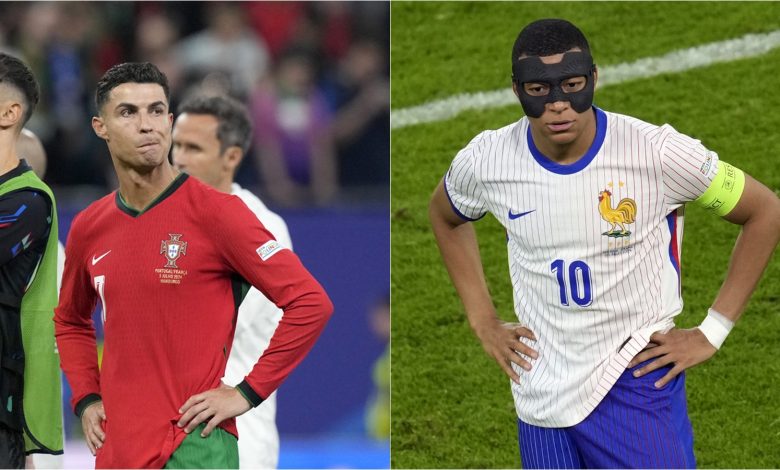

Eyes shut, palms covering his face and pain, Criano Ronaldo stood pensively near the touchline. In a world unto himself, dealing alone with the bitter truth that his team is out of the Euros, he would leave the continental stage without a farewell that befitted his stature. Perhaps, he would never grace in a bigger tournament. The loss seemed undeniably personal, a moment so brutal that he could only think of the self, and not the team. He is his country’s most successful player; its totem and talisman. But when the team needed him to be the leader that stood them in the darkest hours, he slipped into a world of his own. Others, among them the grizzled 41-year-old Pepe, holding back his own tears in possibly his last game for his country, had swept his arms around Joao Felix, whose missed spot-kick differentiated France and Portugal in the shootout after two hours of gruelling, exhaustive football. That’s all Pepe and his teammates cared about at that moment. About the agony of Felix, of the burden he has to bear for the rest of his footballing life, and perhaps beyond it too. It was a raw outpour of human empathy, to ensure that Felix doesn’t feel lonely in his grief.
But Ronaldo was not alone in being alone. His protege, France’s Kylian Mbappe wandered away from his teammates in the dugout, made a crouched perch near the touchline, as though he wanted to experience all the agony and joy himself. He would leap off to the ground when Theo Hernandez hammered the winning spot-kick, but not after a private burst of celebrations. Maybe, he was releasing the compressed pressure of being expected to win every game he plays, score every time he touches the ball, and perform a supernatural act whenever he steps onto the field.
Some supreme athletes are narcissic perhaps because they alone have to shoulder the un-receding waves of expectation of a nation, they alone face the storm when the team loses, they alone inhabit the public consciousness, thus they are lonely in both defeat and victory. Glory, thus, is as much an individual pursuit as it is a collective one.
It’s ego that fuels them to greatness, the belief that their acts of genius could touch a match, it’s the same ego that makes them look selfish too.
Both coaches—Didier Deschamps and Roberto Martinez—deserve criticism for how they have handled them. Portugal’s Martinez has a young team teeming with talent, players perfectly suited to high-pressing high-intensity games. But when one of his 10 outfielders doesn’t press, the team gets outnumbered and outmuscled. Similarly, Mbappe is often reluctant to join the press in his own half. He is waiting in the opponent’s half for the quick counter.
Sadly, the traits of leaders are often contagious. As much as their teammates are inspired the aura of Mbappe and Ronaldo, they let self-obsession seize them in clutch moments. So much so that there were times when 22 men seemed to live on their own planets, as though the rest were strangers. True that their game might not be as studiously drilled as when they play for their clubs, but the lack of communication, or rather not feeling its need, was appalling.
Numerous were the instances where they resorted to ambitious glory shots on goal when passing to your better-positioned teammate was an easier and wiser act to perform. Only 12 minutes had passed when the electric winger Rafael Leão nutmegged Jules Kounde with a marvellous back-heel, sending Nuno Mendes into acres of space. But rather than finding one of his teammates in the middle of the box, he hoofed his wild shot across the far post. The angle was acute, especially for a left-footer from the left-edge of the box. He had to either go outside of the defender and target the near post, or hit with the outside of the boot, a tougher art to master. But he risked the complications, blind and deaf to the pleas of Ronaldo inside the box. A simple cross would have sufficed, and on this occasion, Ronaldo’s rage was justified.
There were moments when Ronaldo felt isolated and complained about the quality of the crosses and the paucity of the service to him in general. When he tried to influence the game on his own, he realised he was a touch too slow to beat the designs of French centre-backs William Saliba and Dayot Upamecano. Ronaldo spilled a routine chance from a sumptuous feed from Francisco Conceicao in extra time. The sculpted body wouldn’t heed to the mind’s whims. And for much of the tournament, Ronaldo’s biggest fight was with Ronaldo himself, against his waning reflexes, his less obedient muscles, against the truth that sun is setting on his career.
Perhaps restricted his shattered nose, Mbappe too was not as supersonic as he was, sporadically peeping out from the pocket of Portugal left-back Joao Cancelo. Later in the game, he assumed a more central role, but both power and precision eluded his shots. And the more he failed, the more shots he attempted, sometimes even the ludicrously impossible.
As though inspired, players of both teams sought outrageous paths to goal, chancing shots from outside the box, their inflated self-belief conquering acquired wisdom and team ethos. Bruno Fernandes would unpack powerful but directionless shots; so would France’s Eduardo Camavinga.
Not just in the vicinity of goal but also in the centre of the pitch would they concede cheap possession when attempting an imprudent trick, an ill-conceived feign, or a wasteful chip. Even the usually selfless Antoine Griezmann lost the wits to pass the ball to one of his nippier men, galloping his side. In a three-on-two situation, he lingered too much on the ball and was dispossessed. Before the game veered to shootout lottery, Ronaldo endeavoured an ambitious overhead kick; France starlet Bradley Barcola jinked past three challengers before slapping an effort from six yards into the tiers.
Both managers, Deschamps especially intolerant to indulgences, would clench their fs and gnash their teeth when such frivolities recurred. But that would continue as the night’s irrevocable pattern. It was fitting that penalty shootouts decided the game, a one-on-one test of skill and steel rather than a fusion of the collective, mirroring the mood and nature of their talismans.