

Microsoft and OpenAI revise deal terms, require external panel to evaluate AGI claims | Technology News
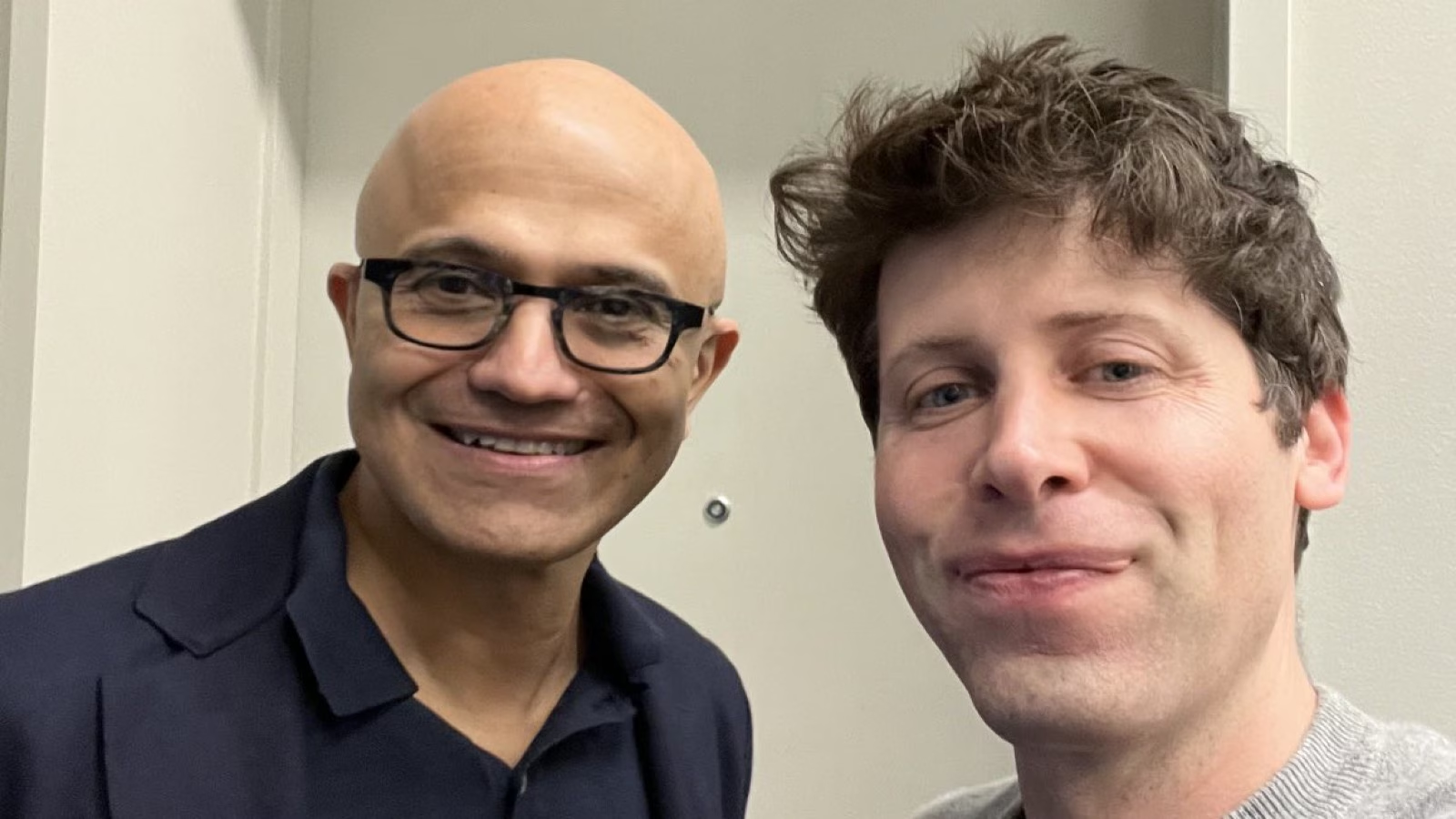

OpenAI’s road to artificial general intelligence (AGI) may have just become more challenging, with an independent panel now responsible for verifying any future AGI claims made the AI startup.The requirement is one of many terms that are part of the ChatGPT-maker’s revised agreement with Microsoft, its biggest partner and investor. “Once AGI is declared OpenAI, that declaration will now be verified an independent expert panel,” read a joint statement published both companies on Tuesday, October 28.
The revised deal also allows OpenAI to restructure itself into a public benefit corporation, following which Microsoft would hold a 27 per cent stake (valued at approximately $135 billion) in the AI startup. Previously, the tech giant held a 32.5 percent stake in the for-profit arm of OpenAI.
Story continues below this ad
The term ‘AGI’ refers to a hypothetical level of intelligence that would enable an AI system to perform complex tasks at the same level or better than humans. The new provisions added to Microsoft and OpenAI’s agreement comes at a time when investors and other stakeholders grow worried that the AI boom is turning into a bubble as Big Tech continues on a spending spree.
Recently, AI/ML research scient Andrej Karpathy revised his projected timelines, stating that it will take another ten years to unlock AGI as no one has been able to develop an AI system that learns continually. “They don’t have continual learning. You can’t just tell them something and they’ll remember it. They’re cognitively lacking and it’s just not working. It will take about a decade to work through all of those issues,” Karpathy said in a recent appearance on a podcast hosted Dwarkesh Patel.
Meanwhile, Microsoft will continue to remain OpenAI’s frontier model partner. This means that the Windows-maker will continue having IP rights of AI models and products developed OpenAI till 2032. This now includes models that have been rolled out post-AGI, as per the revised terms. The revenue-sharing agreement between the two companies will remain only until the expert panel verifies OpenAI’s AGI claim in the future.
For context, the previous version of the contract reportedly stated that Microsoft would have to stop using OpenAI’s models if the latter cracked AGI. Microsoft has invested more than $13 billion in OpenAI. It also used to exclusively provide cloud hosting services to OpenAI via Azure but not anymore. Over the years, the paths of the two companies have appeared to diverge with reports of them being at odds with each other.Story continues below this ad
Microsoft is also now allowed to independently pursue AGI alone or in partnership with third parties. “If Microsoft uses OpenAI’s IP to develop AGI, prior to AGI being declared, the models will be subject to compute thresholds; those thresholds are significantly larger than the size of systems used to train leading models today,” it said.
OpenAI’s consumer hardware excluded
As part of the new agreement, Microsoft no longer holds intellectual property rights to OpenAI’s consumer hardware.
The internet has been buzzing with speculation around OpenAI’s hardware prospects since it acquired the startup founded Jony Ive, the former Apple industrial designer who was behind the iPhone, iPad, Apple Watch, and other Apple hit products. The deal was valued at about $6.4 billion in an all-equity transaction. Ive is also working as creative head to help Sam Altman develop the device that will supposedly be tailored for the AI era.
Besides this, Microsoft will continue to have IP rights to OpenAI’s research until either the expert panel verifies AGI or through 2030, whichever is first. “Research IP includes, for example, models intended for internal deployment or research only. Beyond that research IP does not include model architecture, model weights, inference code, fine-tuning code, and any IP related to data center hardware and software; and Microsoft retains these non-Research IP rights,” the blog post read.Story continues below this ad
While OpenAI is now allowed to jointly develop some products with third parties, its API products developed with third parties will be exclusively hosted on Azure servers, as per the agreement. However, API access provided OpenAI to the US government can be hosted any cloud provider for national security purposes.
Microsoft revealed that OpenAI has purchased an additional $250 billion of Azure services. However, it will no longer have a right of first refusal to be OpenAI’s compute provider. Furthermore, OpenAI is now allowed to release open weight models that meet requisite capability criteria.
