

New solar magnetic discovery could predict solar storms more precisely | Technology News
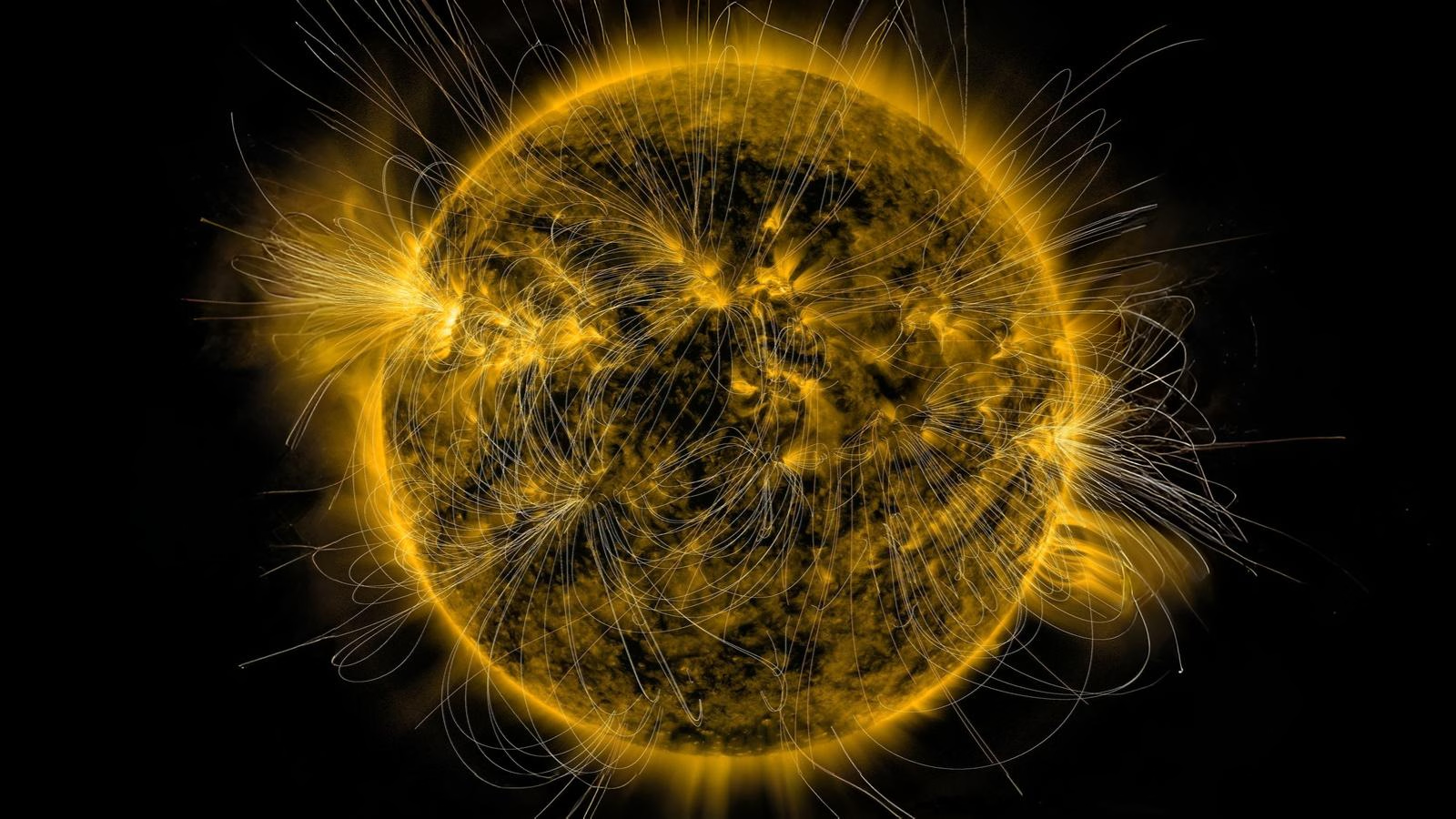

4 min readNew DelhiMar 6, 2026 06:43 PM Scients have discovered new evidence of the small movements of magnetism inside the Sun. This discovery may help them better predict the storms occurring on the Sun.
The new study was conducted scients at the Tata Institute of Fundamental Research (TIFR) in Mumbai and New York University, Abu Dhabi.
Inside the Sun
Scients have used a method to detect the movements inside the Sun. This method is called helioseismology.
This technique is used to study the Sun’s surface to understand the movements inside the Sun. Just as earthquakes are used to study the movements inside the Earth, this technique is used to study the movements inside the Sun.
The scients analysed more than a decade of solar observations collected the Solar Dynamics Observatory, a satellite operated NASA. In particular, they used measurements from the satellite’s Helioseismic and Magnetic Imager, an instrument designed to track oscillations and magnetic activity across the Sun’s surface.
After studying over 5,000 days of data, scients have now detected two types of faint waves that travel through the Sun’s outer layers. These waves seem to be related to what scients call “magneto-Ross waves”, which are large waves that appear in fluids that rotate, especially when magnetic fields and fluid motion combine.
A glimpse of the Sun’s magnetic structure
The newly detected waves seem to be located just beneath the Sun’s surface, an area known as the convection zone. This is where hot Sun plasma rises and falls in huge waves, helping to transport heat towards space.Story continues below this ad
The patterns detected in the Sun’s waves seem to reveal the presence of a huge doughnut-shaped magnetic field inside our Sun. This magnetic field, which is weak near the Sun’s surface, might be quite powerful deeper inside our Sun, especially since the Sun’s plasma is much denser inside than it is on its surface.
This magnetic structure is quite important since it is closely related to what is known as the solar cycle, which is the 11-year cycle over which our Sun’s activity rises and falls.
Why this matters for Earth
Solar activity may impact life and technology on Earth directly. For example, strong solar activity may cause solar flares, which may launch charged particles into space, disrupting satellites, communication systems, navigation signals, and power grids.
Also Read: How did supermassive black holes become such monsters? New study shows it may have been ‘feeding frenzy’
The difficulty in the direct observation of the physics of the solar cycle has made it difficult for scients to forecast solar activity.Story continues below this ad
The recently observed magnetic waves could give scients a new way of tracking what is going on inside the Sun in real time. Scients could also get a precise estimate of the intensity and nature of the magnetic field inside the Sun using this method.
A step towards better space weather forecasts
The discovery also closes a gap in the theoretical and observed solar activity. Scients have theorised for many years that magnetic waves of large scale should ex in the Sun, but directly detecting such activity has been extremely difficult.
With this new evidence, researchers are now starting to see the hidden processes that control the magnetism of the sun. As scients continue to study the solar data, the findings could help improve the forecasting of solar storms.
The ability to more accurately predict solar storms could help space agencies, satellite companies, and energy producers better prepare themselves for the disruptions that occur as a result of the sun’s activities.
Expand © IE Online Media Services Pvt Ltd