‘Not quite a gas planet’: Magma ocean world discovered 35 light-years from Earth | Technology News
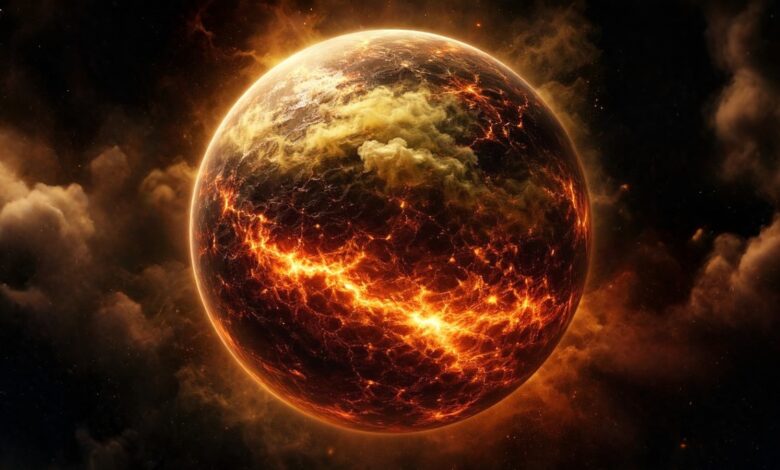

3 min readNew DelhiMar 21, 2026 09:05 PM Astronomers have discovered new information regarding a dant world that could alter scients’ understanding of planets outside our solar system. The planet is called L 98-59 d. It is believed to have a permanent ocean of molten rock beneath its surface and an unusual atmosphere with a lot of volatile gases.
In a recent study published in Nature, it has been mentioned that L 98-59 d, which is located about 35 light-years from Earth, is slightly larger than our planet but has a much lower density, suggesting it is not made purely of rock and metal.
A planet with a molten interior
According to the study, the planet’s interior is likely dominated a long-lasting magma ocean. This molten layer enables gases, such as hydrogen, to be trapped and slowly released over a vast period of time.
This process, scients believe, may help to maintain the atmosphere of the planet. Instead of losing its gases quickly, L 98-59 d appears to recycle them through ongoing interactions between its interior and atmosphere.
Not quite a gas planet, nor a water world
One of the most surprising findings is that the planet does not fit into exing categories. It is neither a typical gas-rich “mini-Neptune” nor a water-heavy world. Instead, its atmosphere appears to be controlled chemical reactions, as well as “volcanic” processes, which are associated with its molten interior.
The research indicates that gases containing sulfur, such as sulfur dioxide, are most likely produced inside the planet through a process of photochemical reaction in a hydrogen-rich environment. This points to a chemically dinct interior unlike anything seen in planets in our own solar system.
Also Read: Astronomers spot violent collision of two exoplanets 11,000 light-years away: ‘It went completely bonkers’
A new way to understand planets
Researchers say L 98-59 d could represent a new class of planets – ones where magma oceans and atmospheric chemry work together over long periods. The findings may explain why so many planets in space come in a variety of different sizes, densities, and atmospheres.Story continues below this ad
The study also demonstrates the evolution of planets over time. L 98-59 d could have started out as a gas-rich planet but eventually evolved into what we see today after losing part of its atmosphere.
Expand © IE Online Media Services Pvt Ltd