Nothing Phone 4a Pro FAQ: Answering a few early questions | Technology News
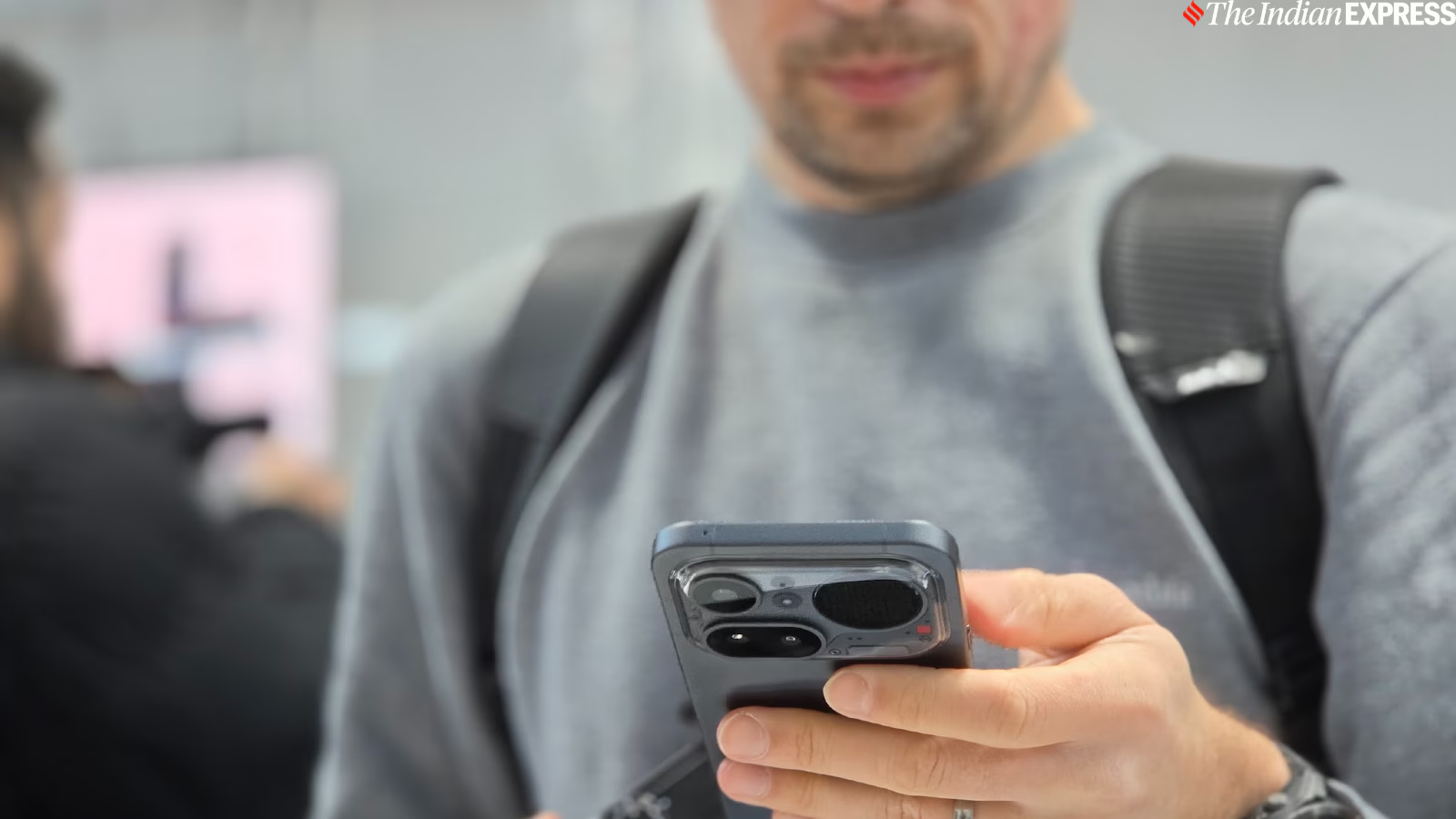

The biggest smartphone news of the week was the debut of the Nothing Phone 4a Pro. There had been no leaks about the device, nor had any renders reached the internet before the launch. I was in attendance and saw the unveiling unfold right in front of me at an event held at Central Saint Martins in London. I spent a few minutes with the Phone 4a Pro during the hands-on session and wrote my first impressions, which you can read at your convenience. In the meantime, I have received a bunch of questions from readers about the device, so I thought I would put together a FAQ-style piece about the Phone 4a Pro.
The reaction to the device has been polarising, but I guess that’s a good sign for a new product that isn’t trying to fit in and is instead creating a space of its own in a crowded smartphone market.
If you are reading a FAQ story now, let me also tell you that I will be reviewing the Nothing Phone 4a Pro, but it will take a few days of testing before I am ready to share what I think about the product.
//www.instagram.com/embed.js
Does the Phone 4a Pro look like the iPhone 17 Pro?
Now that the Phone 4a Pro is with me, I must say that the handset is a fusion of the Phone 4a and the Phone 3, Nothing’s flagship smartphone. At first glance, while watching the product launch video, the Phone 4a Pro may bear a striking resemblance to the iPhone 17 Pro because of the iconic camera plateau, but I have a different take.
I see the Phone 4a Pro as a major departure from the Nothing Phone 1, its debut smartphone. It breaks the consency in design and ditches, if not completely, the semi-translucent design language associated with Nothing. The Phone 4a still sticks to the transparent design, but the Phone 4a Pro does not.
I think Nothing has bigger ambitions for the Phone 4a Pro (perhaps higher internal sales targets). Although consumers have appreciated the translucent, see-through shell that reveals the smartphone’s internal components, the Phone 4a Pro’s all-metal unibody design gives the device a greater sense of maturity and pushes it toward mainstream status. That is exactly what Nothing wants if it aims to compete with heavyweight players, including Apple, and reach a much larger section of users.
I think Nothing took a formula that Apple has executed well: a premium smartphone with a minimal design that caters to almost everyone. It added its own touch but settled on a less dinctive design, favouring an aluminium unibody with a slightly better IP65 rating (vs. IP64) over the heavy use of transparency.Story continues below this ad
The Phone 4a Pro (left) feels both similar to and different from the Phone 4a (right) at the same time. (Image credit: Anuj Bhatia/Indian Express)
I have held the Phone 4a Pro in my hands, and I would say the phone is solidly built and clearly intended to be sold as a mass-market product. It’s a good-looking smartphone, and the screen subtly sinks into the sides of the device. It is also slimmer, coming in at 7.95mm, and looks really sleek. In fact, the camera plateau on the iPhone 17 Pro Max’s back fades over time and becomes somewhat boring. contrast, the Phone 4a Pro constantly reminds you that the area around the camera module (which Nothing calls the “Window”) can be a lot more fun. I will come to the Glyph Matrix a bit later.
That, in itself, is the big story. Translucency is an aesthetic: a design language but not everyone likes it. One reason the iPhone’s design is so widely loved is that people universally appreciate Apple-esque design language. If Nintendo, a company that once made iconic translucent game consoles, had continued with the same design language, things might have been different, but it didn’t. Have you ever wondered why the Switch was never launched with a semi-translucent design, even in a limited-edition capacity? Yes, the Apple iMac G3 was an exception, wrapped in translucent plastic, and the company did experiment with translucent designs for some time, but it eventually shifted to all-white plastic designs for newer Macs.
At the end of the day, it’s about business—and Nothing seems to be making a similar decision. That said, it’s good to see the Phone 4a Pro still retain some elements of transparency within the camera bar. Nothing hasn’t forgotten the transparent elements that helped define the brand, but the focus seems to have shifted toward a new design direction.
Is the Phone 4a Pro’s Glyph Matrix the same as the Glyph Bar on the Phone 4a?
No. There is a key difference between the Phone 4a Pro and the Phone 4a in how Nothing offers its signature Glyph lighting system. On the Phone 4a, the device features a new Glyph Bar, which is made up of 63 mini-LEDs configured into a strip of seven square lights. The Glyph Bar can flash for notifications and calls and can even work with third-party live updates for services like Uber. Honestly, the Glyph Bar is very basic, in my opinion, but it serves the purpose it is intended for, albeit in a less flashy way.Story continues below this ad
As for the Phone 4a Pro, Nothing includes the Glyph Matrix display that made its debut with the flagship Phone 3 last year. It’s a small, circular, monochromatic screen made up of 137 mini-LEDs, offering new widgets and progress tracking for timers, deliveries, or rideshare arrival estimates, but it has lost the capacitive Glyph Button seen on the Phone 3. If you ask me, it’s a neat idea. It feel almost like a secondary display on the back. When I started using the Phone 3 last year, I initially found it to be a gimmick, but slowly and gradually, I began using the Glyph Matrix almost every day for things like the flashlight.
I know many Nothing users who might prefer the Phone 4a’s Glyph Bar over the Phone 4a Pro’s Glyph Matrix. So, the usage of the Glyph interface depends from person to person. I will let my readers decide whether the Phone 4a’s Glyph Bar or the Phone 4a Pro’s Glyph Matrix is better and why.
The Phone 4a Pro has a small monochromatic screen on the back that has a number of different widgets created for it. (Image credit: Anuj Bhatia/Indian Express)
Does the Phone 4a Pro come with a 140x optical zoom?
I have received multiple queries about whether the Phone 4a Pro has a 140x optical zoom. Let me clarify: the phone has a maximum 140x hybrid zoom, which means it is not an optical zoom but a digital one. This means the camera relies on software to magnify the image rather than a dedicated zoom lens. I have already started testing the Phone 4a Pro’s camera in London, but you will have to wait a few more days for details on how the device’s camera performs and how effective the 140x zoom is.
Just to add: while both the Phone 4a and 4a Pro come with a triple camera setup on the back, there is a major difference between them. The Phone 4a Pro offers a superior setup, led a larger Sony LYT700c main sensor. The main difference, however, comes in the form of a 50MP telephoto camera with a maximum 140x hybrid zoom. The Phone 4a, meanwhile, also has a 50MP telephoto camera, but it only offers a 70x hybrid zoom.Story continues below this ad
Essential Apps” are the first step towards Nothing’s “Essential OS” goal, which it views as the future of the smartphone. (Image credit: Anuj Bhatia/Indian Express)
How aggressive is Nothing on the AI bandwagon?
Nothing’s approach to AI is a little less intrusive than that of its peers, who keep adding feature after feature to their smartphones. Nothing OS 4.1 introduces subtle (not drastic) AI features and expands its AI-powered “Essential” apps. The company acknowledges that AI is central to smartphones, and I am particularly looking forward to Nothing’s vibe-coding Essential apps, which allow users to create basic widgets and apps via voice commands.
The Phone 4a Pro comes at a higher price
In a way, both the Phone 4a Pro and 4a are almost identical in internal hardware, with only a few differences. You can read in detail about the differences between the two phones, so I won’t repeat them here. However, the truth is that the Phone 4a Pro comes at a higher cost than the Phone 4a. With a starting price of Rs 39,999 for 8GB of RAM and 128GB of storage, the Pro model is Rs 8,000 more expensive than the base Phone 4a. That being said, the Phone 4a Pro is still a mid-range phone at heart, and so is the Phone 4a. I think the design is the biggest change with the Phone 4a Pro, along with the price difference between the two phones. But I think that’s about it—in a nutshell, that’s all you are missing out on.