

Rare ‘Blood Moon’ lights up sky over India Gate in Delhi, stunning visual surfaces online. Watch
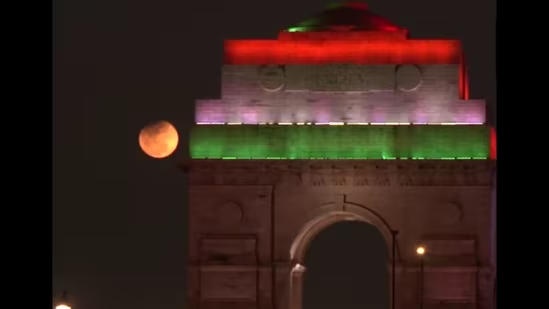

A total lunar eclipse, popularly known as the “Blood Moon”, unfolded on Tuesday evening, drawing skywatchers across the country outdoors for a glimpse of the celestial spectacle. In the national capital, the partial phase of the eclipse was captured against the iconic India Gate, creating striking visuals. A total lunar eclipse, popularly known as the “Blood Moon”, unfolded on Tuesday evening. (X/@ANI)Taking to X, news agency ANI shared the visuals of the partially eclipsed Moon glowing beside the India Gate. “Delhi: The partial Lunar eclipse begins; Visuals of the moon from near India Gate,” the caption of the post read.Watch the video below:The deep red “blood moon” phase has now passed, but the spectacle is not yet over. Observers can still spot a delicate silver arc forming along one edge of the Moon. Over the next hour, the illuminated portion will steadily widen as the Moon emerges from Earth’s shadow and regains its usual brightness.Metropolitans such as New Delhi and Kolkata witnessed the Moon gradually darkening as the eclipse advanced. The celestial event was also visible in several other parts of the country, including Tamil Nadu, Rajasthan, Gujarat, Maharashtra, Odisha and Uttar Pradesh.In Odisha’s Puri, the eclipse created a striking visual as the glowing amber Moon appeared behind the ‘Neel Chakra’ atop the Jagannath Temple, forming a dramatic silhouette against the night sky.Meanwhile, social media platforms were also flooded with images and videos of the shadowed Moon as users shared glimpses of the evening sky from their cities.According to the India Meteorological Department (IMD), the total lunar eclipse on March 3 had a magnitude of 1.155 and was visible across India, as well as parts of Eastern Asia, Australia and the Americas.(Also Read: A US astrologer and former NASA scient explains why the Blood Moon lunar eclipse will be a powerful event)When is the next lunar eclipse expected?A total lunar eclipse happens when the Moon moves completely into Earth’s umbral shadow, whereas a partial lunar eclipse occurs when only a section of the Moon enters the shadow.As the event unfolds, the Moon slowly dims and, at its peak, can appear reddish or copper in colour – a striking effect commonly referred to as the “Blood Moon”. According to NASA, this dinct hue is caused sunlight filtering through Earth’s atmosphere, bending and scattering before illuminating the Moon.The next total lunar eclipse visible from India is not expected until 2029, making Tuesday’s spectacle a rare treat for sky enthusiasts.