Subedaar: Anil Kapoor embodies a war-weary hero, betrayed the very country he bled for | Bollywood News
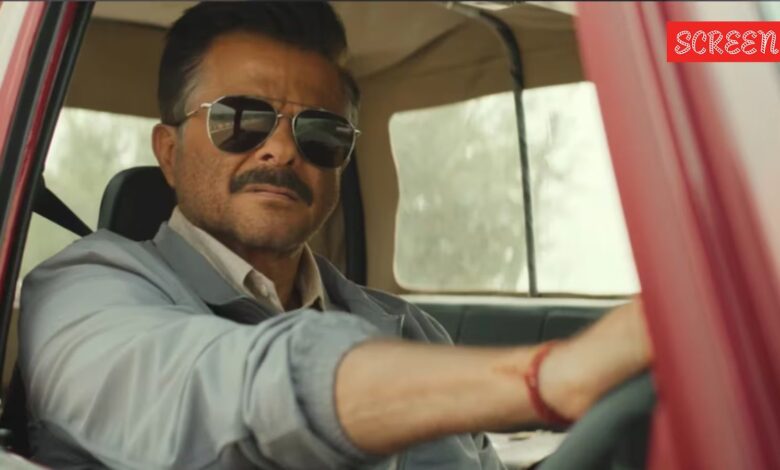

5 min readMumbaiMar 6, 2026 07:00 PM Just a few minutes into Subedaar, Suresh Triveni’s desi Western, the shape of the story begins to reveal itself with a familiar inevitability. You can sense the path before the film even fully settles into its stride. At the centre of it all, is a retired soldier, Arjun (Anil Kapoor) who returns from a lifetime of service only to discover that peace is harder to come than war. Retirement deposits him in a village where every moral hinge has come loose. Nothing works as it should; everything that can go wrong already has. In such a landscape, confrontation is less a question of if than when. It’s only a matter of time before Arjun’s grief of losing his wife hardens into rage. It’s only a matter of time before Arjun turns that rage towards the young local tyrant. And it’s only a matter of time before Arjun becomes the hero his close friend believes him to be. But the tragedy is that he appears exhausted the burden of heroism.
This, in truth, is what the film is concerned with. This is the territory Triveni and his co-writer Prajwal Chandrashekar are circling. The genre, the familiar grammar of the Western, its rituals of provocation and retaliation, becomes less an end in itself than a convenient scaffolding. What they are really digging deeper into is an examination of what heroism demands, what it leaves behind. Because, otherwise, you get a confrontation equivalent to a climactic fight right at the 45-minute mark, where Arjun really gives it back to Prince (Aditya Rawal). From there, the pattern settles into place. Prince burns with the itch for revenge; Arjun tries to retreat into the ordinary business of living; Prince returns to provoke him again; Arjun responds in kind; the cycle continues itself with almost childish persence. And if to complicate matters further, a larger and more inscrutable antagon, Babli (Mona Singh) is introduced, accompanied her watchful aide Softy (Faisal Malik).
Anil Kapoor’s performance in Subedaar can very well be read as a companion to the one he gave in the 2022 western Thar.
Yet the film’s real pleasure lies elsewhere. It is not merely in the mechanics of this cat-and-mouse game, nor in the predictable crescendos of confrontation. It’s not merely in the macro moments, but rather the micro ones which bind the film. It’s very much in the subtextual implications that run through the film. In that sense, Subedaar gradually reveals itself as a kind of character study of Arjun. At this stage in his life, he appears to be grappling with an exential unease. His return to this village confronts him with a kind of disillusionment. For a man who once wore the uniform, for a man who once put his body on the line for the country, for a man who once believed enough in it to stand before bullets, this disillusionment runs deep. It is not just the village that appears broken to him, but the larger promise that once gave his sacrifices meaning. It is not just the system that appears to have failed him, but the very country itself that has let him down.
Also Read | In Konkona Sen Sharma’s Accused, MeToo becomes a narrative prop to pardon its terrible central character of any real consequence
This is where the real test of his heroism begins. We see him grappling with the choices that defined his life, the fact that he was on the battlefield when his wife breathed her last. We see him coming to terms with the dance that now separates him from his daughter, who has grown up hearing about him, yet rarely feeling his presence around her. We see a man who has given the whole of his life to the field, only to return to a land where violence feels even more inherent, more casually consumed. (Kapoor’s performance and the broader arc here can easily be read as a companion piece to another riveting Western he was part of: the 2022 film Thar on Netflix).
In that sense, the film begins to resemble those 1990s potboilers of Sunny Deol and Rajkumar Santoshi, where the hero often needed little more than an excuse to channel his inner frustration and emerge as a moral crusader. It also seems cut from the same cloth as the Angry Young Man phenomenon, though here the rage feels almost incidental. What emerges, then, is a film that appears to stage a battle between the old guard and the new: between Arjun and Prince. Their conflict can just as easily be read as something larger, a metaphor, perhaps, for an older India trying to find its footing within the intolerable, impatient skin of a naya bharat.
Expand
Anas Arif is a prolific Entertainment Journal and Cinematic Analyst at The Indian Express, where he specializes in the intersection of Indian pop culture, auteur-driven cinema, and industrial ethics. His writing is defined a deep-seated commitment to documenting the evolving landscape of Indian entertainment through the lens of critical theory and narrative authorship.
Experience & Career
As a core member of The Indian Express entertainment vertical, Anas has cultivated a unique beat that prioritizes the “craft behind the celebrity.” He has interviewed a vast spectrum of industry veterans, from blockbuster directors like Vijay Krishna Acharya, Sujoy Ghosh, Maneesh Sharma to experimental filmmakers and screenwriters like Anurag Kashyap, Vikramaditya Motwane, Varun Grover, Rajat Kapoor amongst several others. His career is characterized a “Journalism of Courage” approach, where he frequently tackles the ethical implications of mainstream cinema and the socio-political subtext within popular media. He is also the host of the YouTube series Cult Comebacks, where he talks to filmmakers about movies that may not have succeeded initially but have, over time, gained a cult following. The show aims to explore films as works of art, rather than merely commercial ventures designed to earn box office revenue.
Expertise & Focus Areas
Anas’s expertise lies in his ability to deconstruct cinematic works beyond surface-level reviews. His focus areas include:
Auteur Studies: Detailed retrospectives and analyses of filmmakers such as Imtiaz Ali, Anurag Kashyap, and Neeraj Ghaywan, often exploring their central philosophies and creative evolutions.
Cinematic Deconstruction: Examining technical and narrative choices, such as the use of aspect ratios in independent films (Sabar Bonda) or the structural rhythm of iconic soundtracks (Dilwale Dulhania Le Jayenge).
Industrial & Social Ethics: Fearless critique of commercial blockbusters, particularly regarding the promotion of bigoted visions or the marginalization of communities in mainstream scripts.
Exclusive Long-form Interviews: Conducting high-level dialogues with actors and creators to uncover archival anecdotes and future-looking industry insights.
Authoritativeness & Trust
Anas Arif has established himself as a trusted voice consently moving away from standard PR-driven journalism. Whether he is interrogating the “mythology of Shah Rukh Khan” in modern sequels or providing a space for independent filmmakers to discuss the “arithmetic of karma,” his work is rooted in objectivity and extensive research. Readers look to Anas for an educated viewpoint that treats entertainment not just as a commodity, but as a critical reflection of the country’s collective conscience. … Read More
Click here to follow Screen Digital on YouTube and stay updated with the latest from the world of cinema.© IE Online Media Services Pvt Ltd