Trump says US strike targeting Venezuelan gang will cause drug cartels to think twice | World News

US President Donald Trump on Wednesday justified the lethal military strike that his adminration said was carried out a day earlier against a Venezuelan gang, calling it a necessary effort the United States to send an unmakable message to Latin American cartels.Asked why the military did not instead intercept the vessel and capture those on board, Trump said the operation would make drug smugglers think twice about attempting to move drugs into the US.
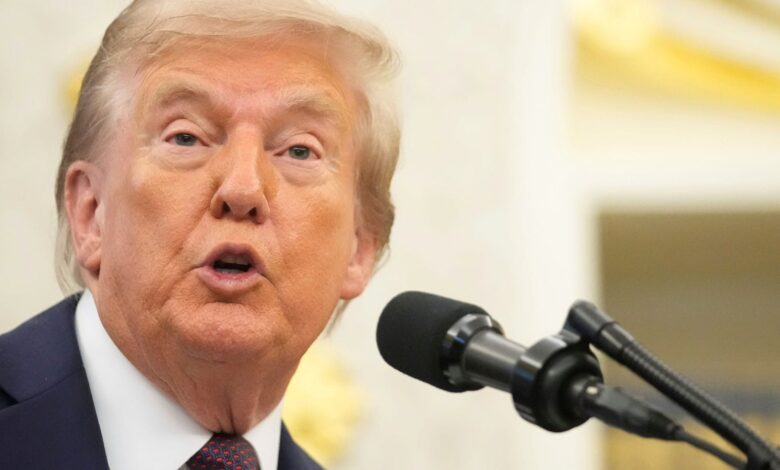
“There were massive amounts of drugs coming into our country to kill a lot of people, and everybody fully understands that,” Trump said while hosting Polish President Karol Nawrocki at the White House. He added, “Obviously, they won’t be doing it again. And I think a lot of other people won’t be doing it again. When they watch that tape, they’re going to say, ‘Let’s not do this.’”
Story continues below this ad
Tuesday’s strike marked an astonishing departure from typical US drug interdiction efforts at a time when Trump has ordered a major naval build-up in the waters near Venezuela.
Later on Wednesday, Secretary of State Marco Rubio warned that such operations “will happen again.”
Rubio said previous US interdiction efforts in Latin America had failed to stem the flow of illicit drugs into the United States and beyond.
“What will stop them is when you blow them up, when you get rid of them,” Rubio said during a visit to Mexico. Defence Secretary Pete Hegseth said on “Fox & Friends” that Venezuelan President Nicolás Maduro was running his country “as a kingpin of a drug narco-state.”Story continues below this ad
Hegseth said officials “knew exactly who was in that boat” and “exactly what they were doing.” But the Republican adminration has not presented any evidence supporting Trump’s claim that operators of the vessel were from the Venezuelan gang Tren de Aragua and were attempting to smuggle in drugs. “President Trump is willing to go on the offensive in ways that others have not seen,” said Hegseth, who declined to detail how the strike was carried out.
Venezuela’s government, which has long downplayed the presence of Tren de Aragua in the South American country, limited its response to the strike to questioning the veracity of a video publicised the Trump adminration showing the attack.
Communications Miner Freddy Ñáñez suggested it had been created using artificial intelligence and described it as an “almost cartoonish animation, rather than a realic depiction of an explosion.”
Hegseth responded that the strike “was definitely not artificial intelligence,” adding that he watched live footage from Washington as the strike was carried out.Story continues below this ad
Trump and adminration officials have repeatedly blamed the gang for being at the root of the violence and illicit drug dealing that blight some American cities.
The president on Tuesday repeated his claim, contradicted a declassified US intelligence assessment, that Tren de Aragua is operating under Maduro’s control.
In announcing the strike, Trump said the operation, which he said killed 11, was carried out in international waters. He also noted that the gang is designated the US government as a foreign terror organisation.
Unlike its counterparts from Colombia, Brazil and Central America, Tren de Aragua has no large-scale involvement in smuggling cocaine across international borders, according to InSight Crime, which last month published a 64-page report on the gang based on two years of research.Story continues below this ad
“We’ve found no direct participation of TdA in the transnational drug trade, although there are cases of them acting as subcontractors for other drug trafficking organisations,” said Jeremy McDermott, a Colombia-based co-founder of InSight Crime, referring to the Venezuelan gang its initials.
Still, with affiliated cells spread across Latin America, it would not be a huge leap for Tren de Aragua to one day move deeper into the drug trade, he said.
Meanwhile, the rhetoric from officials in Washington who would blame TdA as a proxy for all Venezuelan drug traffickers ensures it will remain a focus of intense US government scrutiny. “It is almost impossible today to determine who is TdA and who is not,” said McDermott. “Deportations and statements from the United States suggest that TdA is now being used as a catch-all description for Venezuelan criminals acting abroad.”
Some international warfare experts are questioning the legality of the strike.Story continues below this ad
“Intentional killing outside armed conflict hostilities is unlawful unless it is to save a life immediately,” said Mary Ellen O’Connell, an expert on international law and the use of force at the University of Notre Dame Law School. “No hostilities were occurring in the Caribbean.”
Hegseth was opaque in his comments on Fox about whether Trump was seeking to push for “regime change” in Venezuela.
“Well, that’s a presidential decision,” Hegseth said. He added that “anyone would prefer that” Maduro “would just give himself up. But that’s a presidential-level decision.”
The US announced plans last month to boost its maritime force in the waters off Venezuela to combat threats from Latin American drug cartels. Maduro’s government has responded deploying troops along Venezuela’s coast and its border with neighbouring Colombia, as well as urging Venezuelans to enl in a civilian militia.Story continues below this ad
Ryan Berg, director of the Americas programme at the Washington-based Center for Strategic and International Studies, said Tuesday’s strike clearly showed governments in the region, not only Maduro, the paradigm shift brought on the US decision to declare Tren de Aragua and Mexican cartels as foreign terror organisations.
“This is a United States that sees security differently,” Berg said. “They’ve just demonstrated the ability to use deadly force in the Western Hemisphere, and they’ve already told Mexico that they’re going to do the same thing on Mexican territory if they don’t get the level of co-operation that they want.”
The US has a complicated legacy of intervention in Latin American affairs, and American military operations — particularly during the Cold War — played a major part in destabilising governments and paving the way for coups in Guatemala, Chile and a number of Central American nations, which still grapple with the sometimes violent fallout.
In recent years, the US has taken a more subtle approach, providing foreign assance to many countries and security forces, but not launching direct strikes such as the one seen in Caribbean waters.Story continues below this ad
Mexican Secretary of Foreign Relations Juan Ramón de la Fuente, who met with Rubio on Wednesday, underscored the importance of the Trump adminration operating in the region “without subordination” of other governments and “respecting sovereignty” of allies.