Why Dhoni quit his Railway ticket collector job and Gopi wants respect for sports quota players | Cricket News
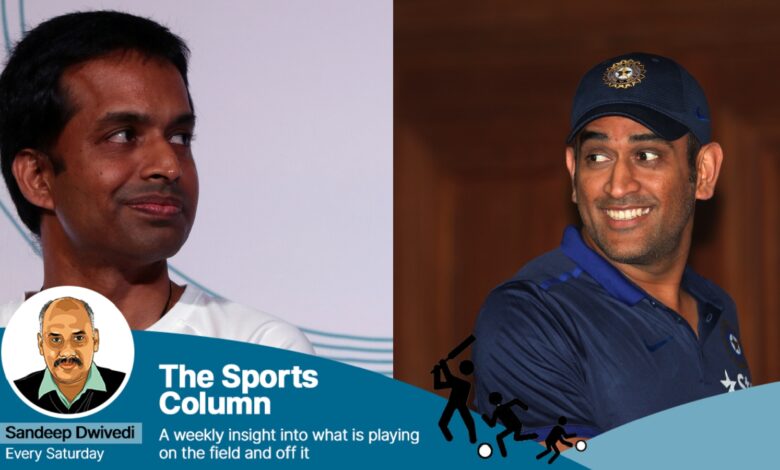

Next time you travel train and spot a fit-looking Ticket Collector (TC) seemingly bored with his job, try remembering the face. The person in the black coat and tie with a reservation chart in hand could be a future sporting star biding his time, tolerating life’s struggles to pursue his grand secret dream.Try taking a picture, you never know, it could be the next MS Dhoni.
National badminton coach and a formidable voice in Indian sport, P Gopichand put that nondescript railway employee under the spotlight when this last week, he articulated the pain and dilemma of those getting sarkari jobs under the sports quota.
Story continues below this ad
With the disclaimer that no employment is lower or higher, he said sportspeople “struggle to find excitement in anything” beyond the sporting arena. Not the least, working as a TC or the president of a sports body. “TC is very tough and others don’t understand the motivation struggle and having to say ‘Yes sir, yes sir’ to IAS officers even when we talk about sports,” Gopi told The Indian Express.
As India gets serious about sports and a large section of youth takes the leap of faith to consider it as a career option, it’s a debate whose time has come and the story of the world’s most famous TC needs an urgent revisit.
The observant among those passing Bengal’s busy Kharagpur railway station in the early 2000s would recall a reluctant railway employee who went on to be a cricketer with a country-wide cult. He had long hair and was an obvious misfit. That budding wicketkeeper-batsman couldn’t juggle the 8-hour shift of poaching ticketless travellers with cricket for too long. He quit and went on to be arguably India’s greatest-ever captain.
The biopic MS Dhoni: The Untold Story captures the turning point of his life in detail. “Papa, if I start thinking of job security, I would never be able to play cricket,” Dhoni tells his father, who is perplexed his son’s decision to walk away from a sarkari naukri.Story continues below this ad
As a budding cricketer with potential and no sponsor, the young Dhoni desperately wanted the Railways job. He was middle-class, and had family responsibilities. The boy from Jharkhand knew that with his father’s pump-operator salary, the family would struggle for funds needed for his ser’s impending marriage. And it was only after he had eased his father’s wedding expenses that Dhoni had a change of heart. Liberated from his family duties, he now thought it was right to be selfish, think about his cricket.
Turning point
The self-driven cricketer knew that if he aspired to have wings and fly high, he couldn’t afford to hang around trains for most part of his day. He said goode to the Railways and the rest is hory.
Are there lessons here? Maybe, but questions for sure. Does a government job scuttle the growth of sportspersons? Does fixed pay, healthcare and pension kill the hunger in athletes? Sarkari jobs provide early endorsement of youngsters with talent, stop them from quitting early, but does it also throw them into an ecosystem that isn’t conducive for outliers with audacious aspirations?
Cricketer Diana Edulji, the former India captain and later a senior Railway officer, doesn’t agree. She talks about 330-plus days of paid leave for athletes and gives several examples of top international sportspersons like Mithali Raj, PT Usha, Sanjay Bangar and Murali Karthik having flourishing careers while working for Railways.Story continues below this ad
But in Dhoni’s case, according to the movie, this wasn’t true. Maybe, it’s because he joined Railways as a rookie and climbed the tough slippery ladder. He was young, he was restless. The clock was ticking, he didn’t want the negativity of his snarky colleagues, who didn’t like the special treatment given to him, to impact his play. There were too many battles to fight, way too many ‘bosses’ to please.
The story goes that once, Dhoni travelled to Delhi for trials for the Indian Railways team. Part of a crowd, he got limited opportunities to show his skills. He was rejected. The coach said that he didn’t have the right technique. Others around there didn’t make the blow softer. “Ticket check kar Kharagpur ja ke, tennis ball khel,” someone taunted.
Years later, in 2009, Dhoni would be leading India in a Test at the Brabourne Stadium. He would score a hundred and the Test win against Sri Lanka would perch India on top of the ICC Test rankings. The same old Railways coach was in the stands. Dhoni would spot him. He would walk to him and, through the fence on the boundary, flash a smile and say: “Sir, ab toh technique thik hai?”.
Dhoni could take rejection but not disrespect. Always. But at playing fields and workplaces of government institutes with sports quota recruits, where official hierarchy is etched in stone, there is a culture of throwing rank. Since the all-powerful signature of an officer can decide the work exemption or leave that athletes need to train, there is rampant sycophancy. At times, this reaches theatrical levels.Story continues below this ad
Sycophancy rules
You could be a gold medall, but a missed ‘Good Morning’ or the absence of that subtle bow in greeting the boss could mean a transfer to some remote outpost. With time, athletes would get used to the system. Getting in the good books of your superiors was as important as getting into the record books. They would learn the trick of swallowing sporting pride while nodding their heads and agreeing with everything the sahebs said. Dhoni failed miserably in doing that.
The movie shows that the trigger that pushed Dhoni to quit his job were his two snitching colleagues. They had their reasons. And this is what makes the ‘sports quota’ debate grey. It isn’t black and white. With Dhoni taking his time to get a grip of office work, others had to work extra. It was human for them to complain. There was nothing diabolical about it. A headquarters inquiry into Dhoni’s shoddy attendance would get initiated. That was to be the last straw. Dhoni would give up the job that he was never cut out to do.
An earlier scene clearly suggested that Dhoni wouldn’t be a TC for long. It was about his trial that his friend, a Railway employee, had arranged for him. The friend had suggested Dhoni’s name to Ganguly sir, the man responsible for sports quota hiring, who would bowl at the applicants.
So, the ageing pot-bellied recruiter would get ready to bowl his loopy slow spinners. In front of him was Dhoni, all set to go ballic. But no one hit Ganguly sir, he had to be indulged. That was the culture. That day Ganguly sir was hit, the balls kept flying out of the ground. The good friend would panic, he would walk towards Dhoni and whisper: “Out ho ja Mahi, nahi toh yeh daalta rahega… naukari ka sawal hai. (Get out Mahi, or he will keep bowling, your job is at stake).” Not really, this was the man who would go on to even take calls on BCCI’s most powerful officials and turn a deaf ear to heavyweight politicians. “Bhaiyya, naukari ke liye out thodi hoyenge. (Brother, why should I get out even if this is about my job!).”Story continues below this ad
Dhoni was one of a kind, a one-in-a-billion cricketer. He would refuse to get out. But those less ambitious, servile and seeking job security and pension would get out to Ganguly Sir. They wouldn’t change, but the system should.
sandydwivedi@gmail.com