

Why so many in Gaza are starving and aid is not reaching them | World News
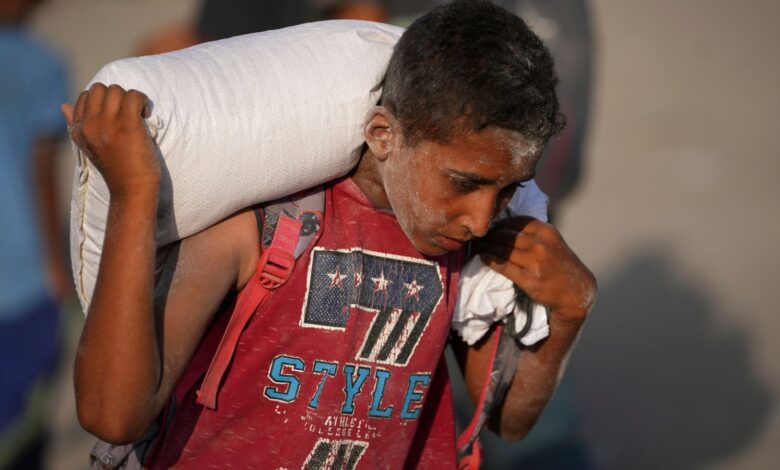

Over the past several weeks, obtaining food in Gaza has become more than difficult, it has become deadly. According to reports, hundreds of Palestinians have been killed while attempting to reach aid sites, many reportedly shot Israeli forces.Others are dying from severe malnutrition, with Gazan health officials confirming dozens of related deaths. But, how did this hunger get so much worse in Gaza?
Israel’s aid blockade and new dribution strategy
The crisis intensified in March, when Israel imposed a total blockade on humanitarian aid entering Gaza, aiming to pressure Hamas and citing, without evidence, that the militant group was seizing supplies. The blockade failed to achieve its political goals but amplified hunger across the enclave.
Story continues below this ad
In May, under growing international pressure, Israel introduced a new aid dribution system in southern and central Gaza through the Gaza Humanitarian Foundation (GHF). While the United Nations had previously dributed aid through hundreds of local sites, the GHF established only four centralised hubs — none of which are in northern Gaza.
This shift meant Gazans had to walk for hours through active war zones to reach aid, with some routes taking three to four hours on foot, the NYT reported.
Palestinians carry sacks of flour unloaded from a humanitarian aid convoy that reached Gaza City from the northern Gaza Strip (AP Photo)
To prevent supplies from reaching Hamas, Israel placed the GHF sites inside its military-controlled zones. That forced Palestinians to cross active military lines. “More than 600 people have been killed while trying to reach the new Gaza Humanitarian Foundation sites,” according to the Gazan Health Minry, as cited The New York Times.
While the GHF denies responsibility for shootings near its sites, it acknowledges that areas beyond its control are “still an active war zone.” Satellite imagery and witness videos reveal crowds of civilians near Israeli tanks and military checkpoints.Story continues below this ad
Live ammunition and unpredictable operations
Palestinian witnesses claim Israeli soldiers have fired live rounds near aid hubs, and the Israeli military confirmed that “its forces had opened fire to disperse crowds” or to respond to what it called “threatening behavior.” An Israeli official admitted that artillery shells had killed civilians near aid sites, calling them “isolated episodes.”
Adding to the chaos, GHF aid sites often open with little notice, and close almost immediately after food runs out. Palestinians line up in the middle of the night, hoping to receive food, only to face violent stampedes or get tear gas thrown US security contractors, according to videos analysed NYT.
Woman looks at the camera as she sits with her child in an area in the northern Gaza Strip, while waiting for trucks with humanitarian aid to arrive, in Gaza City, Friday, July 25, 2025. (AP Photo)
Sometimes, the American security contractors at the sites have thrown tear gas grenades at people crowded into narrow, fenced-in lines with seemingly nowhere to go, as per a report NYT.
One stampede in mid-July killed around 20 people. The GHF claimed “Hamas-linked instigators” triggered the chaos.Story continues below this ad
Rising malnutrition and soaring food prices
Doctors across Gaza report worsening malnutrition, with the World Food Program stating that “more than one in three people aren’t eating for multiple days.” Children have died from starvation, according to Gaza health officials.
Some Palestinians are too weak, old, or frightened to risk walking to the aid zones. Many instead buy resold aid in local markets at astronomical prices. The Gaza Chamber of Commerce reports that tomatoes can cost $30/kg, while sugar exceeds $100/kg.
A 2-year-old malnourished child, poses for a photo at his family home in Shati refugee camp in Gaza City on Wednesday, July 23, 2025. (AP Photo)
After international criticism, Israel resumed aid airdrops, joined countries like Jordan and the UAE. But experts warn that airdrops are expensive, risky, and insufficient to address the growing crisis.
“Airdrops alone are not the answer,” Britain’s foreign minry wrote on social media on Wednesday. “Only trucks can deliver at the scale needed,” it added.Story continues below this ad
Previous airdrops have landed in the sea or in Israel, and some have killed civilians.