
Vance in Islamabad: The $6 Billion Dispute and a ‘Red Line’ Threat That Could Sink the US-Iran Truce
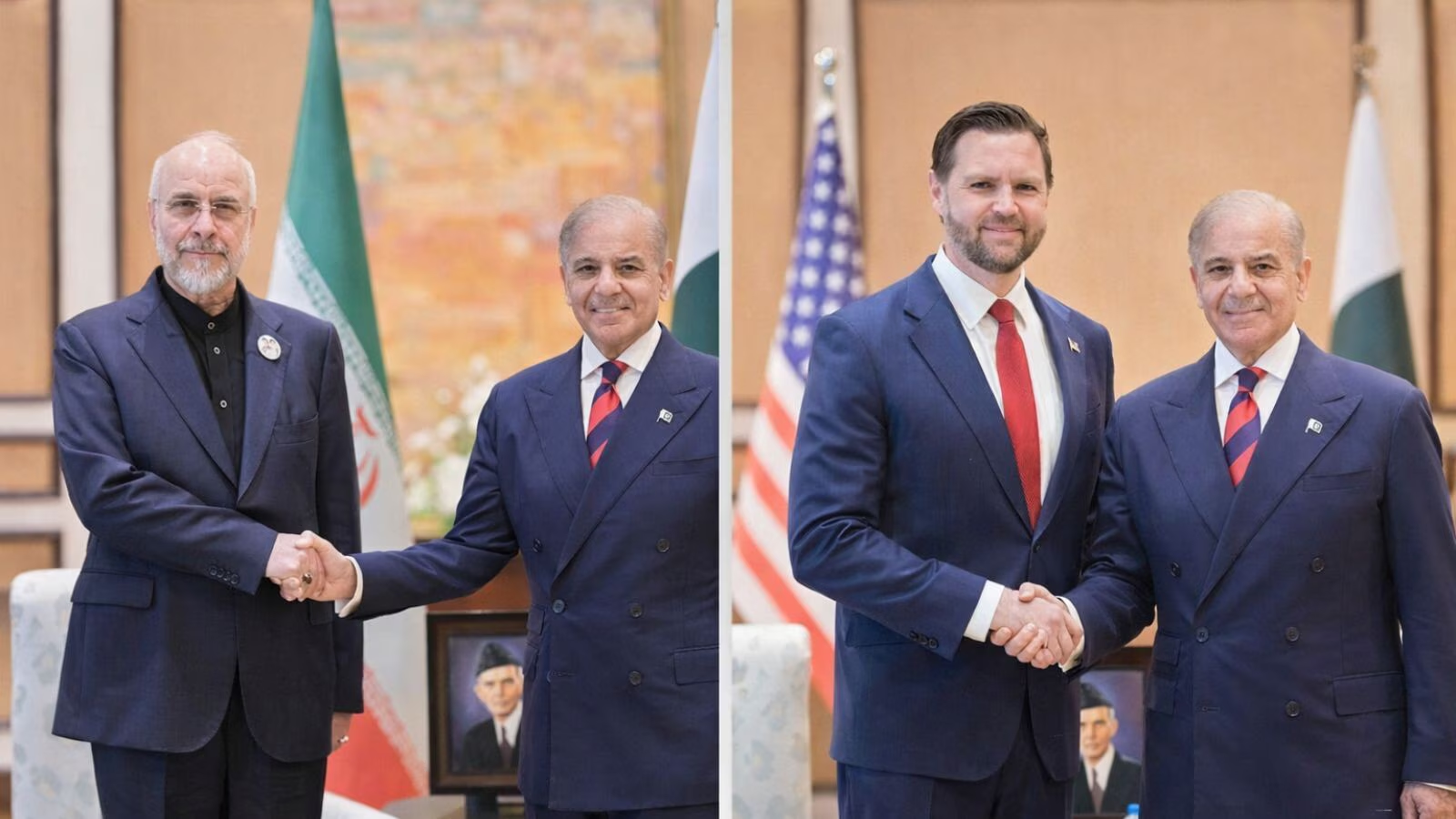

Vice-President JD Vance-led US and Iranian delegations on Saturday met with mediators in Pakan ahead of talks aimed at shoring up a shaky ceasefire and paving the way for a permanent end to the fighting. It marks the first such meeting since the war began more than a month ago.The weekend peace talks got off to a fractious start, dominated a public dispute over frozen Iranian assets and a l of non-negotiable demands from Tehran, even as the two sides avoided meeting each other directly.A senior Iranian source told news agency Reuters that Washington had agreed to unfreeze Iranian assets held in Qatar and other foreign banks, a claim a US official immediately denied. A second Iranian source put the figure at $6 billion, funds originally frozen in 2018 and refrozen the Biden adminration after the October 7, 2023, Hamas attack on Israel, Reuters reported. Qatar’s Foreign Minry did not respond to a request for comment.
Iran tables ‘red lines’ with Pakani leadership
The Iranian delegation, led Parliament Speaker Mohammad Baqer Qalibaf and Foreign Miner Abbas Araghchi, met Prime Miner Shehbaz Sharif and Army Chief General Asim Munir on Saturday morning, Iran’s state-run Press TV reported, according to PTI.
Tehran used those meetings to present several elements of its 10-point proposal as red lines, the AP reported, citing Iranian state television. The demands include compensation for damage from US-Israeli strikes, release of frozen assets, a mechanism for reopening the Strait of Hormuz, and a “tangible and lasting ceasefire” covering Iran and allied theatres, an apparent reference to Hezbollah in Lebanon.
Araghchi warned that Iran was entering negotiations with “deep drust” after being struck during previous rounds of talks, and said Tehran was prepared to retaliate if attacked again, the AP reported.
US delegation meets Sharif; Trump ramps up pressure
The US delegation – Vance, special envoy Steve Witkoff and Jared Kushner – arrived later Saturday and met Sharif, Pakan’s Foreign Office confirmed.Story continues below this ad
“Commending the commitment of both delegations to engage constructively, the Prime Miner expressed the hope that these talks would serve as a stepping stone toward durable peace in the region,” the Foreign Office statement said, as reported PTI.
President Trump posted repeatedly on social media ahead of the talks, saying Iranian officials “have no cards” to negotiate with. “The only reason they are alive today is to negotiate!” he wrote.
He said separately on Saturday that large numbers of empty oil tankers were heading to the US to load up with oil and gas.
10-point vs 15-point: Where the two proposals clash
The competing frameworks underscore the dance between the two sides, the AP reported. Iran’s plan demands a guaranteed end to the war, no future attacks, the lifting of economic sanctions, and control over the Strait of Hormuz. Washington’s 15-point counter focuses on restricting Iran’s nuclear programme and reopening the strait.Story continues below this ad
The strait remains Iran’s biggest strategic lever. Only 12 ships have been recorded passing through since the ceasefire was announced, against more than 100 a day before the war, AP reported. Brent crude stood at around $97 on Friday, up over 30% since the conflict began on February 28. Iran has floated charging ships for passage, an idea widely rejected, including the US and Oman.
★ Day One → Escalation ● The Toll ⚖ The Ceasefire ✦ What Now?
✦ FEBRUARY 28, 2026
Operation Epic Fury — The Opening Salvo
At 06:35 UTC, CENTCOM announced joint US-Israeli airstrikes against Iran — launched while nuclear negotiations were still underway. B-2 stealth bombers, B-1 Lancers and B-52 Stratofortresses struck missile sites, command-and-control infrastructure and radar installations. Israeli fighter jets carried out decapitation strikes, killing Supreme Leader Ali Khamenei at his residential compound. Iran retaliated within hours, launching hundreds of ballic missiles and drones at Israel and US bases across six Gulf states. Tehran closed the Strait of Hormuz, shutting off 20% of global oil supply.
✶
6
Gulf states hit Iranian retaliation
✈
200+
Israeli jets in largest-ever combat sortie
⚓
20%
Global oil supply through Hormuz — now shut
★
Decapitation strikes
Khamenei and several top officials killed at his residential compound. Defence Miner Nasirzadeh and IRGC commander Pakpour also confirmed dead.
→
Iran’s retaliation
Hundreds of missiles and drones targeted Israel, US bases in Bahrain, Kuwait, Qatar, UAE, Jordan and Saudi Arabia. A drone struck Britain’s Akrotiri base on Cyprus.
⚓
Hormuz blockade
Iran’s IRGC Navy blew up 10 commercial vessels attempting to transit the strait. A critical chokepoint for ~20% of global oil was sealed shut.
→ Key Milestones — March 1 to April 7
✈ MAR 1 — DAY 2
Dubai airport damaged Iranian drone strikes. Flights across the Middle East came to a near-complete halt. Iranian missiles hit Bahrain, Kuwait, Saudi Arabia and UAE.
◆ MAR 6 — DAY 7
Trump posts on Truth Social demanding Iran’s “unconditional surrender.” Iran dismisses the statement.
★ MAR 7 — DAY 8
Assembly of Experts appoints Mojtaba Khamenei, son of the slain leader, as Iran’s new Supreme Leader — considered more hawkish than his father.
⛽ MID-MARCH — DAYS 15–20
Kharg Island — Iran’s oil export hub — bombed. UNHCR reports 3 million internally displaced. More than 30 universities struck. IRIS Dena frigate sunk USS Charlotte near Sri Lanka.
● MAR 28 — DAY 29
CENTCOM confirms 11,000+ targets struck across Iran. Joint strikes hit Iran University of Science and Technology among civilian sites.
✶ APR 3 — DAY 35
US F-15E Strike Eagle shot down over Iran — first US fighter jet loss. Crew ejected; pilot rescued same day, weapons systems officer found alive 48 hours later. A-10 Warthog also downed near Strait of Hormuz.
⚖ APR 5 — DAY 37
Pakan proposes 45-day ceasefire. Iran rejects it, submits its own 10-point peace plan instead. Trump threatens to destroy Iran’s power plants and bridges.
⏱ APR 7 — DAY 39
Trump issues deadline: total destruction of Iranian infrastructure if Hormuz not reopened 8pm Washington time. Iran’s military calls threats “delusional.”
● Human Cost — As of April 8
✶
3,636
Killed in Iran (HRANA, Apr 7)
✶
1,784
Killed in Lebanon (Health Minry)
↔
3M
Internally displaced in Iran
◆
13
US service members killed
◆
28
Killed in Gulf states
● Global Fallout
⚓
Strait of Hormuz blockade
Closed since Feb 28. Post-ceasefire traffic at roughly 10% of normal. Over 600 vessels stranded in the Gulf region, per Lloyd’s L.
✈
Aviation disruption
Dubai International Airport damaged on Day 2, briefly halting all flights. Middle East air travel came to a near-complete stop.
⛽
Energy shock
Brent crude hit $119.50/barrel. Saudi SATORP refinery shut after attack. IEA released 400 million barrels from global reserves. US gas prices up 55 cents year-on-year.
✶
Hardware losses
US: F-15E and A-10 shot down; 5 refuelling tankers damaged at Prince Sultan Air Base. Iran: 19 warships sunk, 1 submarine destroyed, 30+ minelayers hit.
⚖ APRIL 7–8, 2026
Pakan Brokers a Two-Week Truce
After 40 days of war, Pakani PM Shehbaz Sharif mediated a ceasefire between the US and Iran. Trump announced the suspension of attacks on condition Iran reopens the Strait of Hormuz. Iran’s Supreme National Security Council claimed “nearly all war objectives have been achieved.” Israel endorsed the truce with Iran but said it does not extend to Lebanon — a position Iran and Pakan both dispute.
⚖ US Terms vs Iran’s 10-Point Plan
★ US DEMANDS
End nuclear program
Dismantle enrichment capability in exchange for civilian nuclear investment
✦ IRAN’S PLAN
Right to enrich uranium
Pledge not to build nuclear weapons, but retain enrichment capability
★ US DEMANDS
Reopen Hormuz freely
Full restoration of free international passage
✦ IRAN’S PLAN
Controlled passage
Transit coordinated with Iran’s armed forces; Iran and Oman charge fees for reconstruction
★ US DEMANDS
Cut proxy support
Restrict Iran’s backing of armed groups including Hezbollah
✦ IRAN’S PLAN
US troops out of Gulf
Full withdrawal of US combat forces from all regional bases
✦ ISLAMABAD TALKS — APR 10–11
High-Stakes Negotiations Begin
VP JD Vance, envoys Steve Witkoff and Jared Kushner arrived in Islamabad on April 10. Iran’s delegation — led Parliament Speaker Mohammad Bagher Qalibaf and FM Abbas Araghchi — is using Tehran’s 10-point plan as the basis for talks. PM Sharif invited both sides to negotiate “a conclusive agreement to settle all disputes.”
✶ FLASHPOINT — LEBANON
Israel’s Offensive Threatens to Unravel the Truce
Israel launched massive airstrikes on Lebanon on the day the ceasefire was announced — killing 303 people on April 8 alone. Netanyahu inss the truce does not cover Lebanon. Iran has warned it may exit the ceasefire if attacks on Hezbollah continue. US-brokered Israel-Lebanon talks are expected in Washington next week.
⚓ HORMUZ STATUS
Strait Still Operating at a Trickle
Despite ceasefire terms requiring Iran to reopen the waterway, only about a dozen ships transited in the first two days. Shipping analysts say 600+ vessels remain stranded, and even at normal pace, clearing the backlog would take over 10 days. Iran says passage requires coordination with its armed forces.
Sources: Al Jazeera · CENTCOM · HRANA · TIME · CBS News · NBC News · NPR · CNN · Britannica · Lloyd’s L
Israel strikes in Lebanon threaten to derail ceasefire
Israel pressed ahead with strikes in Lebanon on Saturday even as Iran conditioned the talks on a pause in fighting there. The strikes killed at least three people, AP reported, citing Lebanon’s state-run news agency.
Separate Israel-Lebanon negotiations are expected to begin Tuesday in Washington, the office of Lebanese President Joseph Aoun said, AP reported. Israel wants Beirut to take responsibility for disarming Hezbollah, but it remains unclear whether Lebanon’s army can enforce such a demand.
Israel’s insence that any Iran ceasefire does not cover its Hezbollah campaign has threatened to sink the deal. On the day the truce was announced, Israeli strikes on Beirut killed more than 300 people, the war’s deadliest day in Lebanon, according to the Lebanese Health Minry.Story continues below this ad
War has killed nearly 5,000 across the Gulf
The conflict, now in its seventh week, has killed at least 3,000 people in Iran, 1,953 in Lebanon, 23 in Israel and more than a dozen in Gulf Arab states, AP reported. It has largely severed the Persian Gulf from the global economy, sending energy prices surging and damaging infrastructure across half a dozen countries.
In Tehran, residents expressed cautious hope. “If we get concrete and final results, there is still a chance that the deal falls through,” Shahab Banitaba told the AP.
(With inputs from agencies)