

Will US use its ‘bunker buster’ bomb on Iran’s fortified nuclear site? What may happen if it did | World News
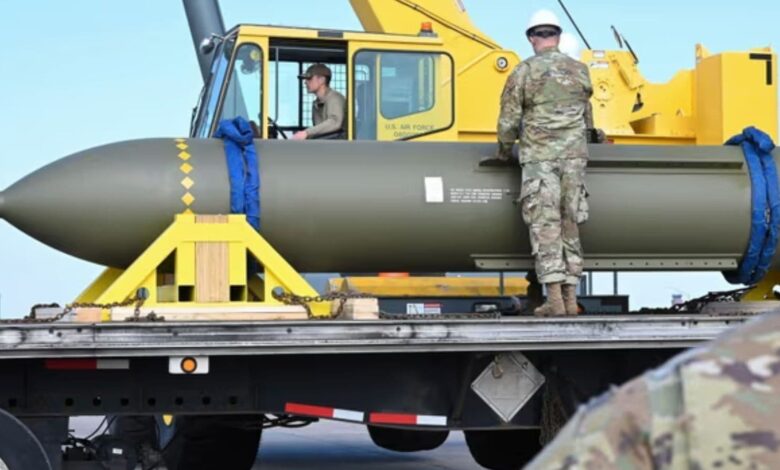

As Israel steps up its military campaign to dismantle Iran’s nuclear programme, questions are being raised about whether the United States could deploy one of its most powerful non-nuclear weapons, the GBU-57 A/B Massive Ordnance Penetrator, or “bunker buster”.Israel claims Iran is nearing the capability to build a nuclear weapon, with much of its enriched uranium reportedly housed in the heavily fortified Fordow facility buried deep inside a mountain in northwestern Iran. It is one of the most secure sites in the region, designed to withstand conventional strikes.
The bomb is commonly known as a “bunker buster” as it was designed to destroy underground bunkers, like Fordow, the 30,000-pound bomb can punch through 200 feet of earth or concrete before detonating. However, it can be carried only a B2 bomber that has air superiority and requires a solid GPS signal to lock in on its target.
Story continues below this ad
As per reports The Guardian, US President Donald Trump has suggested to defense officials it would make sense for the US to launch strikes against Iran only if the “bunker buster” bomb was guaranteed to destroy the enrichment facility at Fordow, according to people familiar with the deliberations.
“You make sure you save them for places like Iran and North Korea because you don’t need something that goes that deep,” said ABC News contributor and retired Col. Steve Ganyard. He added that while the bomb carries 5,000 pounds of explosives, “it wouldn’t be a massive blast. It would penetrate the ground and shoot up some debris but it won’t be a massive cloud.”
The bomb has never been used in combat and remains exclusive to the US military. Only the B-2 Spirit stealth bomber — also operated solely the US is capable of delivering it. These bombers are stationed at Whiteman Air Force Base in Missouri and would need about 15 hours to reach Iran if deployed, military experts say, ABC news reported.
That deployment seems technically possible, as Ganyard noted Israel has already destroyed much of Iran’s air defence network, making stealth less critical in this scenario.Story continues below this ad
How deep is Iran’s Fordow nuclear facility?
Iran’s Fordow Fuel Enrichment Plant, located roughly 95 km southwest of Tehran, is built into the side of a mountain and lies approximately 260 to 300 feet underground — a depth designed to withstand airstrikes and even bunker-buster bombs, Al Jazeera reported.
This satellite image provided Maxar Technologies shows the Fordow enrichment facility in Iran on Jan. 24, 2025. (Maxar Technologies via AP)
Construction on the Fordow site is believed to have started around 2006, and it became operational 2009 — the same year Iran publicly acknowledged its exence. Under the 2015 Joint Comprehensive Plan of Action (JCPOA), Iran agreed to suspend enrichment at Fordow and repurpose the site into a research facility. However, following the US withdrawal from the deal in 2018, Tehran resumed uranium enrichment activities at the location, maintaining that its nuclear programme is intended for peaceful purposes.
According to Al Jazeera, the facility is reportedly protected Iranian and Russian surface-to-air missile systems, though some of those defences may have been hit in recent Israeli strikes.
The potential for US involvement in the current conflict remains unclear. Trump, who has voiced strong support for Israel’s actions, has so far stayed noncommittal about American military engagement. However, Trump has repeatedly warned Iran’s leadership over its alleged nuclear ambitions.Story continues below this ad
Iran has denied pursuing a nuclear weapon, and international observers remain on high alert. The head of the International Atomic Energy Agency (IAEA), Rafael Mariano Grossi, last week warned against attacks on nuclear facilities.
“Such attacks have serious implications for nuclear safety, security and safeguards, as well as regional and international peace and security,” Grossi said.