
Where Jews and Arab Americans live side side, renewed hope | World News

The question Rabbi Michael Moskowitz expected didn’t come right away.
Story continues below this ad
At Temple Shir Shalom in suburban Detroit on Friday night, roughly 60 congregants had gathered in the sanctuary for Sukkot, the festival of thanksgiving that commemorates the Israelites’ desert wandering. A vaulted ceiling and blond wood framed the space, which held the cantor’s voice in an aching reverberation.
The ceasefire between Israel and Hamas had been announced just days earlier, setting the stage for the first wave of hostages to return and offering a tentative pause after 24 months of brutal conflict. The war, ignited the killing of about 1,200 Israelis, had claimed more than 67,000 people in the Gaza Strip, according to local health officials. (Their tolls do not dinguish between combatants and civilians.)
For metropolitan Detroit — home to one of the largest Arab American populations in the United States and a vibrant, deeply rooted Jewish community — the ceasefire landed less as a celebration than as a shared, complicated quiet. Relief and joy mixed with mrust. Hope was tempered fatigue and worry.
“Our tradition is one based on gratitude,” Moskowitz told his congregation. “A year ago in Israel, Sukkot didn’t really take place. People were in such pain, so exhausted.” Now, he said, they could for a moment simply breathe.
At the end of the service, the rabbi opened the floor for questions. No one asked about the peace deal, the returned hostages or the future. The congregants filed out without articulating what everyone was surely thinking.
“I was waiting for it to come,” Moskowitz said later in a temple hallway. “I thought for sure someone would ask.” But none did. It was as if they didn’t want to jinx the precarious moment, he said.
Tessa Hewitson, 21, standing with her mother in the temple’s lob, understood. “This is also not committing to something that hasn’t happened yet,” she said. In Jewish tradition, she explained, families do not celebrate a pregnancy too early — you hold back until the good news is fully real.
“We’re holding our breath,” she said. “Not waiting. Holding our breath.”
The dinction mattered, she said. Waiting is passive. Holding your breath is active, a choice to suspend yourself between one moment and the next.
That was Friday. Monday morning, that breath began to release. Twenty living hostages crossed back into Israel. Video showed them stepping off buses, embraced family members, tears streaming down faces. At Temple Shir Shalom, Moskowitz sent an email to his congregation: “Overwhelmed and feeling such relief,” he wrote. “And even a little hope.”
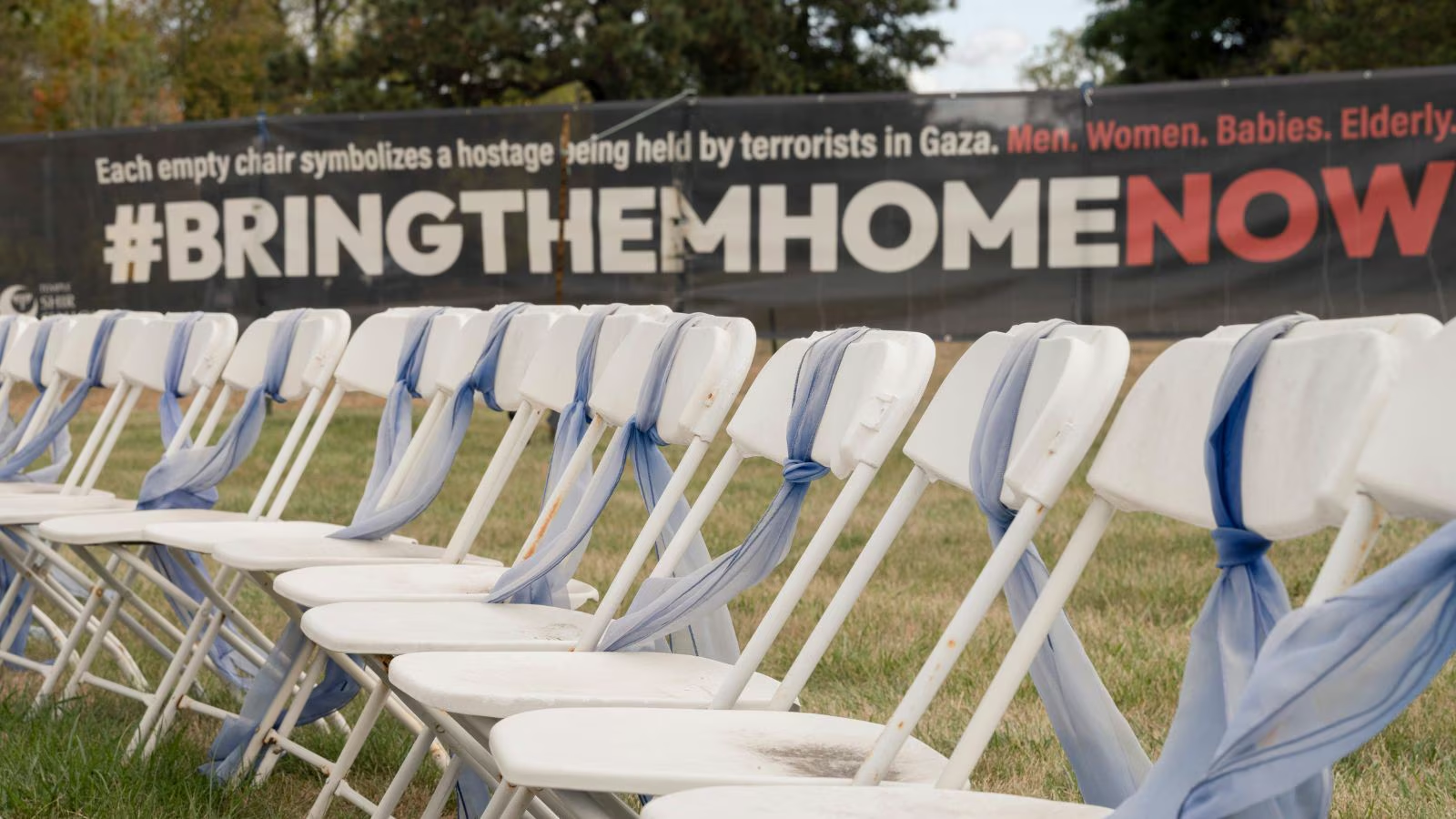
The chairs that had stood on the temple lawn since October 2023 — 251 at first, each representing a hostage — had become a constant witness. They “have stood as a physical manifestation of our faith and our resolve,” the rabbi wrote in the email. That evening, the congregation would gather to remove 20 of them, he announced, one for each living hostage expected to return home. “Tears fill our eyes,” he wrote. “Air fills our lungs. Our children are back home.”
About 18 miles south, skepticism ran deep in Dearborn Heights, where the Arab American community has strong roots. Imam Hassan Qazwini stood before the construction site that will soon be the new mosque for his longtime congregation: the Islamic Institute of America. Five golden domes, symbolizing the Prophet Muhammad and his family, had been lifted into place last week.
Inside, thousands will eventually pray together. On Saturday, though, with the ceasefire announcement fresh, Qazwini measured his words. “I am glad to have an end to this devastating war,” he said.
The numbers haunted him. The tens of thousands dead in Gaza. About 2 million displaced. The orphans, the injured, the devastation of an entire territory. And now this deal, brokered President Donald Trump, a man viewed with deep drust in the imam’s community and Arab Americans nationally.
“I have my doubts about whether Israel will follow through,” Qazwini said. He pointed to Lebanon, where past ceasefires had been declared but missile strikes had continued. He mentioned a local heartbreak: a family with Michigan ties, all except one child killed in an Israeli attack.
“There is a common belief in our community that the president is doing this, not because he is interested in peace in the Middle East,” the imam said about Trump’s peace efforts. “Rather, he is interested in a Nobel Peace Prize.”
Even if the ceasefire holds, he said, it’s a “difficult thing to feel” genuine happiness about Trump’s role when the broader outcome may be “a superficial peace agreement.”
Above him the golden domes gleamed. The mosque is scheduled to open in a few months — God willing, the imam said.
For years, Moskowitz and Qazwini had been building a friendship. They shared meals and talked about bridging divides between their communities. When a white supremac murdered 11 people at the Tree of Life synagogue in Pittsburgh in 2018, Qazwini came to Temple Shir Shalom to stand with the grieving community.
Then came Oct. 7. The trauma was instant and absolute. Their connection went silent.
Both men professed over the weekend their belief that their friendship could eventually return. The rabbi spoke of a necessary healing that still needed to happen before they could engage again. The imam agreed, noting that the cleavage in their connection was a microcosm of a larger geopolitical stalemate.
In the Detroit area, Jews and Arab Americans live side side, work together and send their children to the same schools. There has always been tension alongside remarkable coexence. Now, that same closeness creates a different kind of tension, the strain of neighbors who carry opposing griefs, who read the same headlines and draw opposite, often painful conclusions.
Saturday morning, Moskowitz sat in a conference room at Temple Shir Shalom for his regular Torah study session with about a dozen congregants. The questions came quickly, a flood released after the stillness of Friday night.
What about the Palestinian protesters on college campuses? Will there ever be a two-state solution?
“Aspirationally, I believe in that,” Moskowitz said about the two-state solution. “I think that’s what Israel needs ultimately to make it more secure.” He noted roadblocks — an Israeli government that does not want such a setup, and questions about whether such a state could be a trusted neighbor. “How we get there,” he said, “I’m not sure.”
The rabbi rejected a one-state solution or the annexation of the West Bank as bad for Israel’s long-term security.
The conversation inevitably turned to Trump, the unlikely figure involved in securing the deal. Acknowledgment of the president’s role seemed to come grudgingly from some in the room, a political concession extracted reality. Moskowitz relayed a conversation with a progressive religious teacher in Jerusalem, who said, “How can we not thank Trump right now?”
The rabbi said the teacher’s feeling was shared many. “We have to give thanks to President Trump for moving us in this direction. Israelis feel that way, too.”
Moskowitz continued, conveying his understanding of a reported back-and-forth between Trump and Israeli Prime Miner Benjamin Netanyahu. “Netanyahu said, ‘People are going to like me again.’ And Trump said: ‘People are going to like Israel again. It’s not about you.’”
Moskowitz, no fan of either leader, laughed wryly. “I mean, the narciss is calling out the narciss!”
The most difficult query came from a congregant who asked directly about the innocent lives lost in Gaza. The rabbi confirmed what he had stated during prayers the night before — they mourned all innocent lives, Israeli and Palestinian both, because this is what Jewish values require. He cited the ancient concept of “Tzedek, tzedek tirdof” — a Hebrew phrase meaning “Justice, justice shall you pursue” — asserting that pursuing justice demands acknowledging the humanity of those on the other side.
Detroit’s Jewish and Arab American communities continue to ex in parallel, actively suspending themselves between trauma and solace, happiness and whatever comes next.
“People are all holding their breath, waiting to see what is going to happen in the future” said Dave Abdallah, a regular at the mosque.
True coexence is worth the work, Hewitson said. “It’s going to be tough, but everybody is ready.” She paused. “We’re committed to hope. It’s the only choice we have.”
Monday evening, as the sun set, more than 100 congregants gathered on the lawn of Temple Shir Shalom for a ceremony. The chairs there had stood throughout this ordeal, through rain and snow, though negotiations that failed and negotiations that succeeded.
Moskowitz called forward 24 children. Hewitson helped direct them. The children each took one chair — 20 for the living hostages who had returned home that day, four for the bodies that had been recovered.
Twenty-four chairs came down. Twenty-four remained on the lawn, representing hostages whose bodies were still in Gaza, their families still waiting for closure.
Prayers for peace continue at the synagogue and the mosque. Separated miles and months of silence, two men who were once friends wait for the day when connection becomes possible again.
For now, the ceasefire holds.