Astronomers identify 27 potential twin-sun planets similar to Star Wars’ Tatooine | Technology News
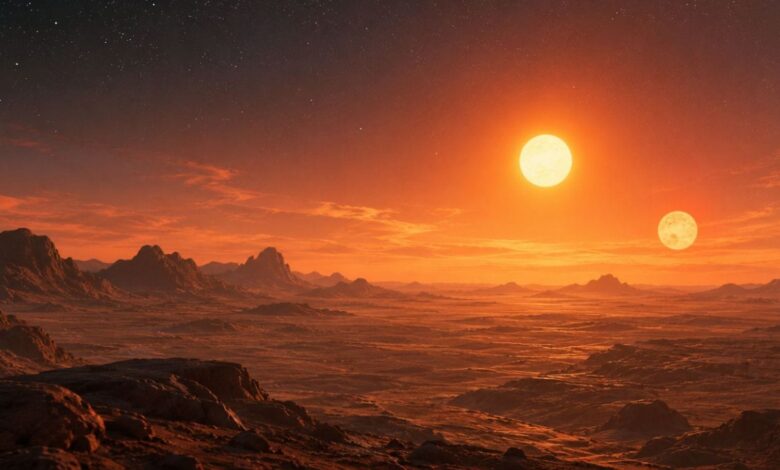

4 min readDelhiMay 6, 2026 04:05 PM Astronomers have identified 27 potential circumbinary planet candidates, worlds that may orbit two stars, similar to the fictional planet Tatooine from Star Wars.
The candidates were detected using eclipse timing variations in binary star systems observed NASA’s Transiting Exoplanet Survey Satellite (TESS), though further observations are needed to confirm whether they are truly planets. About 18 circumbinary planets had been discovered, and more than 6,000 planets have been recognised which orbit around single stars.
In a periodical publication for Star Wars Day, which is on 4th May, scients discovered about 30 more candidate planets with their dances ranging from 650 to 18,000 light years away from the Earth.
“There are many things in astronomy that aren’t very tangible… Everyone has a picture of what a circumbinary planet looks like and what it would mean to stand on a planet with two suns,” Ben Monet, associate professor at the University of New South Wales, told The Guardian.
More than half of the stars in the universe ex in multiple or binary star systems. Scients identify circumbinary planets through transits – when a planet passes in front of a star. “It casts a shadow on the star’s surface; we see a dip in the star’s brightness … and we can infer there’s something orbiting it,” Montet said.
This happens when the planet and its stars align perfectly with the line of sight from Earth. “We’re missing lots of systems, potentially,” he added.
“Planets are hard to find. It’s like trying to see a candle right next to a big streetlight.”Story continues below this ad
The scients used a method called “apsidal precession” in which they search for a movement between the stars which orbit around and eclipse one another.
Also Read: Could Pluto be a planet again? Nasa chief sparks fresh debate
The study’s lead author and PhD candidate at UNSW, Margo Thornton, said, “If we monitor the exact timing of these eclipses … that can tell us that there’s something else going on in the system.”
After elimination of factors like rotation and gravitational pull of the two stars, the team discovered 36 star systems out of 1,590 whose behaviour could only be explained a third body.
For 27 of those objects, it is possible that they are planet-mass. More research into their spectra – the light they emit – was needed to formally confirm them as circumbinary planets. “It’s just a matter of: what is the mass of it? Is it a planet? Is it a brown dwarf? Is it a star?” said Thornton.Story continues below this ad
The team recognised the potential planets – likely ranging from Neptune-sized to ten times heavier than Jupiter – using data from NASA’s Transiting Exoplanet Survey Satellite, which is a planet-searching space telescope that was launched in 2018.
The team’s “very clever techniques” could be used to find more planet candidates in the future, said Dr Sara Webb, an astrophysic at the Swinburne University of Technology who was not involved in the research.
Circumbinary planets would likely have extreme environments unlike anything in our solar system, Webb said.
According to Dr Webb, a Tatooine-like planet could theoretically ex in a habitable zone between two stars, where temperatures are neither too extreme nor too cold. She added that when the original Star Wars films were released, scients had not yet discovered exoplanets. She added that ideas first imagined in art and science fiction are often later reflected in real scientific discoveries about the universe.Story continues below this ad
The research was published in the Monthly Notices of the Royal Astronomical Society.
(This article has been curated Seekriti Saha, who is an intern with The Indian Express.)
Expand © The Indian Express Pvt Ltd