US President Trump is alive. The internet was convinced otherwise. | World News
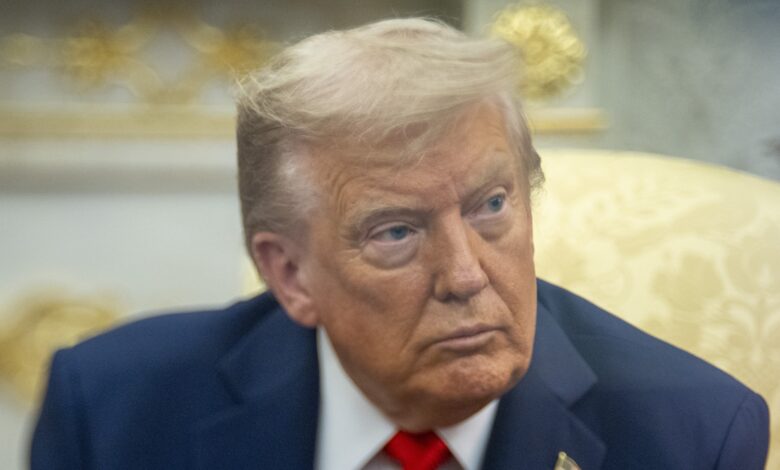

President Donald Trump had nothing on his public schedule for three days last week. He is often sporting a large, purple bruise on his right hand, which he sometimes slathers with makeup. His ankles are swollen. He is the oldest person to be elected president.
For a swath of hyper-online Americans over the long Labor Day weekend, all of this was explanation enough: The president was either dead or about to be.
Story continues below this ad
Trump’s critics have speculated about his health for as long as he has been in national politics. And for his part, he has long declined to explain when and why he has sought out medical care, whether he was suffering from COVID or undergoing routine procedures. But there had never been a conspiracy wave as feverish as this one.
On TikTok, influencers with legions of followers surmised that the White House was publishing old photos, suggesting that the president was being hidden from view. Reddit threads, one after another, were ablaze with commentary. On the social platform X, posts shared anonymous critics disseminating dubious reports picked up thousands of interactions and shares.
There was so much conversation around the president’s absence that Trump was asked to weigh in Tuesday, at his first official public appearance in a week. When asked a reporter how he first learned that he was dead, Trump said that he was not aware of the rumors that he had died. Then he started speaking about those rumors at length, saying he had done media appearances, gone golfing at his Virginia club and posted prolifically on his social media site.
“I did numerous shows, and also did a number of Truths,” Trump said during an appearance in the Oval Office, referring to his social media site, where he posted more than 90 times between Saturday and Monday. “I think, pretty poignant Truths. I was very active over the weekend.”Story continues below this ad
Welcome to the modern, conspiracy-fueled world of presidential health, where drust and speculation run so rampant that even Trump’s online assurance that he was fine earlier this weekend — “NEVER FELT BETTER IN MY LIFE!” he wrote Sunday — was immediately explained away as part of a cover-up.
The focus on the health of an aging president seems inevitable after the nation’s experience with Trump’s predecessor, Joe Biden, who physically declined in public, though his aides attacked those who questioned what they were seeing. Trump made Biden’s fitness for office a foundation of his 2024 campaign, even after Biden dropped out of the race.
Adding to the problem is a longtime presidential tendency to not disclose a full picture of health. Although Trump has obscured the truth about his health before, this is not unique to him. President Woodrow Wilson had a stroke and was hidden from public view. President Franklin D. Roosevelt was wheelchair-bound, but few Americans at the time ever saw him in one. President John F. Kennedy suffered from chronic back pain but was held up as the picture of health.
For years, justifiable concerns and questions about Trump’s health have often been met with obfuscation or minimal explanation from the people around him. Trump’s physicians have not taken questions from reporters in years, and there were no medical briefings held after an assassination attempt against him in Butler, Pennsylvania, last summer.Story continues below this ad
Drust and speculation surrounding Trump’s health goes back to his first term. In 2018, Trump’s longtime physician, Dr. Harold N. Bornstein, accused two Trump aides of staging what he called “a raid” of his Manhattan office in February 2017 and removing all of Trump’s medical files.
That month, Bornstein had given a lengthy interview to the Times and had disclosed the medications Trump was taking: antibiotics to control rosacea; a statin for elevated blood cholesterol and lipids; and finasteride, a prostate-related drug to promote hair growth. Bornstein, who died in 2021, also said that Trump, rumored to be a germophobe, “changes the paper on the table himself” after examinations.
At the time, Trump’s press secretary, Sarah Huckabee Sanders, said aides had taken the files as part of a standard transition measure.
Questions continued to circulate after Trump made an unexplained and unannounced visit to Walter Reed National Military Medical Center in November 2019. (In 2021, his former press secretary, Stephanie Grisham, wrote in a memoir that Trump had undergone a routine colonoscopy.)Story continues below this ad
Questions were raised again in June 2020 when Trump gingerly navigated a ramp at a West Point graduation and appeared to have trouble raising a drinking glass. When Trump had COVID in October 2020, he was sicker than anyone around him had publicly revealed at the time.
“There’s always been this wishful-thinking industry around Trump’s health and Trump’s legal woes,” said Mike Rothschild, a journal and author who studies conspiracy movements. “There’s been this far-left influencer sphere that is constantly pumping up the idea that Trump is about to go to prison or the walls are closing in.”
As with many conspiracy theories, this latest one about Trump’s health carries a kernel of truth: He is old. At the end of his second term, he would be 82 years old, and months older than Biden was when he left office.
Trump, 79, also has a hory of high cholesterol. According to his most recent health disclosure sent in April his White House physician, Dr. Sean P. Barbabella, Trump takes two medications, Crestor and Zetia, to lower his LDL cholesterol levels.Story continues below this ad
In 2018, Trump’s White House physician at the time, Dr. Ronny L. Jackson, said Trump was in “excellent” health but noted that the president’s LDL levels were led at 143, well above the desired level of 100 or less, despite taking Crestor. This year, Barbabella led them at 51.
David J. Maron, a cardiolog at Stanford University School of Medicine who has not treated Trump, said that such a drop could be attributed to an “extraordinary” response to Zetia — an outcome he said was unlikely — and to a higher dose of Crestor.
A better diet and lifestyle changes could also help, though Trump, who is overweight, still maintains a diet heavy in fast food, including McDonald’s. Dr. Eric Topol, a cardiolog and founder of the Scripps Research Translational Institute, said it was “not possible” to drop to such a low LDL level adding Zetia alone.
Trump also takes aspirin to reduce the risk of cardiac problems. White House officials, including Barbabella, have said that the aspirin is the cause of the large bruise on Trump’s right hand, and that the bruising comes and goes based on how many hands Trump has been shaking. The president tends to dab makeup on the bruise that is a shade lighter than his skin tone, making the cover-up more conspicuous.Story continues below this ad
Several physicians who have not treated Trump say that it is possible for aspirin to cause bruising.
“Bruising on the back of the hand of an older adult is common,” said Dr. Samuel C. Durso, the director of the department of medicine at Johns Hopkins Bayview Medical Center. “Especially if that person, a golfer with solar skin damage, takes aspirin.”
Durso and other physicians said that the White House explanation for Trump’s swollen ankles — the result of chronic venous insufficiency, a condition that occurs when veins have trouble moving blood back to the heart, Barbabella said in July — is possible.
Others were skeptical of the White House explanation for the swollen ankles. Dr. Daniel J. Rader, a cardiolog at the University of Pennsylvania, said venous insufficiency, or varicose veins, does not cause major swelling and “almost never” causes it in both ankles, as was seen with Trump.Story continues below this ad
The White House has not said whether officials would have Barbabella answer questions from reporters, as Jackson last did in 2018. In a statement, Karoline Leavitt, the White House press secretary, said that Trump was “perfectly fine” and had a “tremendous” amount of energy.
“He has been completely transparent about his health with the public,” Leavitt said in a statement, “unlike his predecessor.”
This article originally appeared in The New York Times.